
Cammie Doder (00:05):
Welcome to Money Tales, where Money gets Personal. I’m Cammie Doder
Sandi Bragar (00:09):
And I’m Sandi Bragar.
Cammie Doder (00:11):
What if sustainability is not just about the planet or even your work, but about your relationship with money? In this episode, Denise Dunning, founder of Rise Up Together shares how the idea of sustainability shapes everything from how she leads a global nonprofit to how she earns, saves and raises her children. Her story reveals that building a meaningful financial life is not about extremes, but about creating something that can endure.
Sandi Bragar (00:39):
Here are three money conversations. This episode will help you navigate. First, when does a strong saving mindset become a hidden limitation? A lifetime focus on security and frugality can build stability, and it can also create hesitation around investing and taking thoughtful financial risks. Second, how do early money experiences shape the way you see value? Growing up with financial insecurity can instill discipline and independence, while also reinforcing a persistent sense of worry about money. And third, what does it look like to build a sustainable relationship with money? Aligning, spending, saving and giving with your values can create a sense of balance that supports both your financial life and overall wellbeing. Now it’s our pleasure to bring you Denise Dunnings Money Tales. Welcome to Money Tales. Denise Dunning, we’re so glad you’re here to join us today.
Denise Dunning (01:37):
Thanks so much. I’m delighted to be here.
Sandi Bragar (01:39):
I know that you are a world traveler and have lived in many countries. I just got back from a vacation overseas and had a really interesting to me money experience. I’m actually kind of embarrassed to tell this story as a highly experienced wealth manager for many decades, but my husband and I were in Europe. It’s so easy to travel in Europe compared to the first time I went to Europe as a college student. Several decades back, you can just use your phone to pay for things and you don’t really cash very often. But we were taking a couple of tours where we needed to pay the tour guides in cash, and so we found ourselves running over Florence, Italy trying to find an ATM where we could withdraw money without incurring any of the Euro net charges. We put our card in the ATM and it told us that if we withdrew money, we’d have to pay a 6% fee to the bank for the pleasures of taking money out. So we said no thank you, and pressed decline. And all of a sudden 400 euros was flying out of the ATM machine.
Cammie Doder (02:54):
I think you won.
Sandi Bragar (02:55):
Well, no, because they charged. I was thinking
Cammie Doder (02:58):
They charged
Sandi Bragar (02:58):
Of 6%. I was going a little bit.
Cammie Doder (03:03):
That’s what I had, Denise.
Sandi Bragar (03:04):
I know. And so you think 6%, that sounds huge now on 400 euro. It’s not the end of the world, but it really got me stewing because that was not our intent. We were heads up, I hate little money, things like that. They just drive me crazy. And I was on vacation and I just found myself stewing on this and I thought, oh my gosh, what’s wrong with me? It just wasn’t a lot of money.
Cammie Doder (03:29):
It is. It’s such a big percentage. It feels wasteful. I’d
Sandi Bragar (03:35):
Be the same way. I think it was because I know better than that, right? And then there’s clearly a flaw with this machine, and I was thinking, oh, we should go. It was a holiday weekend. We should go to the bank on Tuesday and I should tell them that their machine’s broken, broken
Cammie Doder (03:48):
6%
Sandi Bragar (03:49):
Back.
(03:50):
And I’m like, but wait. This is vacation. I don’t want to spend time on Tuesday trying to speak to an Italian banker. I was able to finally let it go and just be like, this is not the end of the world. Because clearly it really, really wasn’t. But it was interesting to pause to realize what was happening to me and to try to address my own mental blocks around money. As it turns out, when I checked my bank account a couple days later when the charge had processed, the amount taken out of our account didn’t include a 6% fee. It was just the exchange rate. So I don’t know what happened there. It was totally weird, but I got myself crazy and was able to ultimately pull myself back. And thankfully it didn’t cost me the extra $40 or whatever it would’ve been.
Cammie Doder (04:40):
I think it’s an important point and I am just curious, how did you pull yourself out? I am very similar to you, Sandi. It drives me nuts. I feel like that’s wasted money, but you don’t want to ruin your vacation and it’s small and whatnot. But is there anything that you would share?
Sandi Bragar (04:56):
Yes, because I just contextualized it more, right? In
Cammie Doder (04:59):
The
Sandi Bragar (04:59):
Grand scheme of our vacation and what we were spending, this wasn’t a big dollar amount. It wasn’t going to make or break our financial lives. It was just an annoying little piece of travel. So that’s how I got over it. But embarrassingly, it did take me a little while to do it.
Denise Dunning (05:20):
And my husband will laugh at me. I will drive extra minutes to go to the gas station that’s 5 cents cheaper per gallon. And he’s like, how much did you actually spend to do the extra drive to get the right? Because you want to feel, that’s the psychological piece. You want to feel like it’s money well spent and time well spent and are, at least for me, the trade-offs of money and time are not always quite spot on as they should be because sometimes I spend more time worrying about little bits of money that aren’t really that.
Sandi Bragar (05:50):
Yes, and that is the challenge I think of money and human psychology and our experience. And I think a lot of it too has to also do with the fact that we all work hard for our money and we don’t want to be wasteful, and we’re smart women and we know how to use money well. And so
Cammie Doder (06:08):
These
Sandi Bragar (06:08):
Little blips happen. You get stuck thinking, wait, I know better, and I actually pressed the correct button. What happened here?
Cammie Doder (06:16):
Well, it’s a great story, and Denise, I appreciate you jumping in and sharing that these emotional approaches to money are as important, right? It’s just who we are and it makes us feel good. And then you got to check in. Does it make sense? Can we pivot over to you and would you introduce yourself and share a couple pivotal moments that influenced who you are today?
Denise Dunning (06:37):
Yeah, thank you. So my name is Denise Raquel Dunning. I live in San Francisco. I’m the founder and executive director of a nonprofit called Rise Up Together. And what we do is support leaders around the world to improve health and education and economic rights and climate solutions both globally and here in the us. I’m a mom of three. I’ve got two teenagers and a 10-year-old, and a few pivotal moments when I saw this question in your lineup of questions you had shared. One that came to mind is not one I’ve ever talked about in a public setting, but I tell my kids about it often. When I was growing up, I never really quite fit in. My mom was foreign. We were different. I was always trying to fit in but never quite fit in. And that I remember in fifth grade, never being one of the cool kids. I had my friends and whatnot, but I was never cool and I never fit in. And I remember walking out of the coat closet and some other kids walking in towards me and they looked at me. I don’t remember who this kid was at this point. They looked at me, we crossed, we locked I and crossed paths, and they said, you’re weird. And I don’t know what happened in that moment, but I just looked at them and I smiled this big smile
(07:57):
And I said, thank you. And it was this flip in my brain of I don’t have to fit in. I don’t have to try to play a game that I’m not going to win. And that there’s strength and power in being weird and being yourself. So when I saw your question, that was the first one that came to mind. I
Cammie Doder (08:16):
Love that. It’s incredible.
Sandi Bragar (08:17):
And how old were you?
Denise Dunning (08:19):
Oh, fifth grade. So maybe 11. Oh
Sandi Bragar (08:22):
My gosh, that’s amazing.
Cammie Doder (08:23):
That’s such confidence. That is such confidence. Well, I want to hear more about growing up, but before we get there, tell us what was the last money conversation you had? Tell us a little bit about that.
Denise Dunning (08:35):
The last money conversation that I had was probably at work. I run a nonprofit. We raise money to support the leaders that we work with around the world who are creating game changing solutions for women and girls and doing tremendously powerful work. And we’re about a $7 million organization. And one of our largest longtime funders unfortunately, had a shift in their funding strategy. And so is cutting our funding. They’re still going to fund us, but at a much lower level. And so we’ve had a lot of conversations about what is that going to mean? How are we going to navigate this? How can we continue to do the impactful work that we do at scale? We’ve been able to impact 172 million people since we started in 2009.
Cammie Doder (09:25):
Wow.
Denise Dunning (09:26):
So we really believe in the work we do. Our leaders are creating these transformational changes for women and girls. And the reality is that philanthropy is changing rapidly and it’s really hard to sustain this kind of work with funding that is constantly changing.
Sandi Bragar (09:43):
And how are you feeling in that conversation? Because I know that’s something that happens to nonprofits all the time, but you’re a brand new,
Denise Dunning (09:52):
Fully
Sandi Bragar (09:52):
Fledged nonprofit.
Denise Dunning (09:53):
Exactly right. So we’ve been around 16 years, but we were part of a larger nonprofit and we went independent six months ago in October. It’s actually really helpful to remember. And I was talking to a friend of mine who said that’s what the nonprofit sector is. And really in many cases, the corporate sector too is you grow and then you retrench and then you grow and then you retrench. And we haven’t had that experience. Our experience has been one of steady but constant growth over the years. And we were very fortunate that we received a large gift from Mackenzie Scott in 2021 that really catapulted us to the next level. But remembering that that is how the sector works and that we will adjust and adapt and just keep on moving forward.
Cammie Doder (10:36):
Wow, that’s so important. And it reflects that your world is you’re constantly talking about money while also doing this incredible work you do, right? It’s so important. Tell us your backstory. How did you first start learning about money when you were growing up?
Denise Dunning (10:52):
From my parents, of course, who have very interesting money stories, my father was born in 1923 on a farm in Nebraska. So during the depression, no running water and no electricity, one room schoolhouse. And he ended up fighting on World War ii and because of that, had the GI bill and was able to go to college and grad school. So I grew up super, super, super humble and very poor. My mom, very different in some ways. Her parents were Jewish refugees who left Germany, migrated to Bolivia, and then eventually Argentina, which is where she was born. So she grew up also extremely poor. Her family had lost everything. She grew up in Buenos Aires, came to the US in her late twenties for work as an immigrant, shared an apartment with six other young women her own age. And so for my parents, money was always a source of worry.
(11:49):
They were financially secure. My dad worked in federal government, so they were secure. And it wasn’t like we weren’t going to make rent, but there was ever a lot of money to go around. So I remember them talking about money a lot and worrying about money a lot. And I grew up with the belief of what we started this conversation about the value of money and that there’s some things that are cheap and those could be of good value. There’s some things that are expensive and those could be of good value, but it’s important to have value. You don’t want to pay away too much for something that’s not valuable or always do the cheap thing. Sometimes the value is not there either. So value is always something that we talked about. And I remember the expression whenever I wanted, whatever I wanted as a teenager growing up was money doesn’t grow on trees. So it was like, if you want that thing, that one too. Yeah, go out, do your babysitting, do your job, whatever the case may be, earn your own money if you want to buy that thing, that pair of jeans or whatever the case may be because money doesn’t grow on trees and you got to figure it out for yourself.
Sandi Bragar (12:51):
So what did you do with that message, Denise, as you were growing up and especially as you were looking to pivot toward your own career in adult life?
Denise Dunning (13:00):
I mean, I think I really took it to heart. I’ve always been really frugal. I’ve always been a saver. My mom, I think taught me the most about money. She was the one who worried the most. So she worked my whole life. She’s now alive and retired, so she’s no longer working. But she worked my whole childhood and what she always said, she didn’t really like her job often, but what she always said was that as a woman, you have to be able to depend on yourself financially and you don’t ever want to have to depend on someone else to take care of you financially. So I really grew up with that as core to my own belief system for myself. And it’s also very much connected to my work because a lot of what we do is support women and girls around the world to have economic freedom and opportunities in their own communities and in the work that they do as well.
Cammie Doder (13:55):
Growing up as a, or even today, you’re a frugal saver. And I’m curious, that works really well. I mean, that’s a great way to live and really resonates with me. And I’m curious looking at that and thinking about your life, does it ever hold you back?
Denise Dunning (14:12):
It absolutely does because people laugh at me about this one, but until I was well into my adult years that I was ever even willing to consider investing, everything I did was put money into CDs,
Cammie Doder (14:25):
Safe, safe, safe,
Denise Dunning (14:26):
Right, safe, safe, safe. CDs are safe, that they’re secure as opposed to investments which can go up, but they can also come way down. And so I think I have an over level of concern about financial risk that has held me back from making more strategic investments because I always feel like if I’m going to earn it, I have to save it and I have to keep it and I can’t do anything that might actually be risky.
Sandi Bragar (14:52):
It’s interesting to hear you talk about that, Denise, because I am hearing you say those words and I’m thinking about the important work that you do at rise up together and the investments that you’re making in all of these women and girls around the world, which is such a big investment,
Cammie Doder (15:10):
A different type of investment, right. Sandi,
Sandi Bragar (15:12):
That you sort of maybe compartmentalized a little differently. My words maybe,
Denise Dunning (15:18):
But I actually think it’s easy for me because it’s a very safe investment.
Sandi Bragar (15:23):
Say more about that.
Denise Dunning (15:24):
We’re investing in leaders who already know the needs and challenges in their own communities know what the changes need to be. And our investment in them is leadership and advocacy, training, funding to support their strategies and campaigns and then support to amplify their impact. What we’ve seen through evaluations over the years, I mentioned our leaders have been able to impact 172 million people since we started. And so when we’re selecting our leaders, yes, there’s always an element of risk of maybe something’s going to go wrong or it won’t go as they hope. And that often happens because this work is hard and it’s not like everyone is going to be a bullseye. But we also have seen time and time again that these are leaders and organizations that are positioned to create a scale of impact that is unimaginable if we were trying to do this work ourselves.
(16:18):
One example that I’ll give you is one of our leaders in India, her name is am, and she was really concerned with two things. One, economic opportunities for women and girls, which can be very limited. And then two were the terrible, very high profile, gender-based violence and rape cases on public transit. If you remember, there were several of these cases a few years ago in India and she wanted to do something about both of those. And so what she was able to do was advocate with the deli public transport system because what she had done was do some research and she found that only men could be bus drivers. It was not actually written into the law, it was not written into policy, but it was the defacto practice. So to be a bus driver in Delhi, you had to be a certain height, you had to be able to lift a certain amount of weight, things that really were written so that only men could do this job.
(17:13):
And so when she found this out, she said, well, why is that? No woman’s going to have to lift the bus as long as you’re tall enough to see over the steering wheel, that’s all it should take. And so she was actually able to engage with the deli public transit to change this policy and launch a new pilot initiative for women drivers in the deli public transit system. And so now they’ve had these groups of women coming through this training program to become bus drivers. And so what that means is not only it’s a new economic vehicle vehicle, pun pun intended, I wasn’t even intended that one. It’s a job and career trajectory that was not open to women before. That is well paying stable job one, two is it increases public safety on buses, right? Because there is a woman in power in that space so that if something starts to happen, if you’re a young woman under threat, you have someone that you feel like you can go to.
(18:10):
And then three, it’s the whole, if you see it, you can be it. And so now a little girl gets on a bus and she sees a female bus driver. And so she thinks that there’s an opportunity for her other than the cooking and the cleaning and everything else that she sees at home. It’s those kinds of leaders that we’re investing in who understand the local context, understand what the needs are, and have really creative and strategic ideas to create large scale change for women and girls. And so yes, it’s definitely an important investment, but it doesn’t feel risky at all.
Sandi Bragar (18:41):
I love that example, and I love your reasons for why it’s not feeling risky, but if we go back to a more traditional investment, I think there’s parallels because I think about traditional investing as making an investment in economic activity. It’s not as specific as the example you just mentioned, but certainly to the extent you’re investing in stocks and companies that are producing products or providing some service that is helping other people, and there’s economic benefit there. So I’m just wondering how you see that investing with your money outside of your organization differently.
Denise Dunning (19:22):
If I had spent more of my life learning about this whole world of investment, I think it might not feel as different for me, it’s not something I focused on. And so it feels a little bit like money flies through the air and I might put it over here and have a good investment that goes well, and I might put it over here and that might tank. And so that has been more the concern. Not that I don’t do any investing, but it is something that I feel more reticent about as opposed to the work that I do that I just feel very confident that the impacts will be worth the investment that we’re making.
Sandi Bragar (20:02):
So it sounds like it is just about familiarity and understanding exactly what’s at stake and what’s happening under the hood.
Cammie Doder (20:09):
And
Sandi Bragar (20:09):
I’m curious, just to dwell on this for a moment longer, Denise, you said it for a long time, you were most comfortable investing in CDs and things that’s just sort of ticked up over time and value. What caused you to move into a more diversified investment portfolio as you matured?
Denise Dunning (20:28):
I was in part getting married and my husband, he’s not an investment person either, but he understands it better than I do and is more interested in it than I have been. And so we will talk about that and think about this opportunity versus that one. And so that has made me more comfortable with it over time.
Cammie Doder (20:48):
It’s so nice. I mean, I think that that’s part of what we’re advocating for, that the conversations can free us up where we express our limitations or something that is holding it, not limitations, but something holding us back. And I think there’s a really powerful Oh, me too. Or some guidance along the way. Denise, you’ve traveled the world, you’re impacting the world. I’m curious from, this is a big question or it could be a very broad question, but maybe one or two places where you’ve been and or lived that you feel have had a really healthy relationship with money and tell us why you think that’s the case.
Denise Dunning (21:26):
It’s hard to generalize about an
Cammie Doder (21:28):
Entire
Denise Dunning (21:28):
Place or an entire country. I don’t know that this is true. This is just my own stereotype, again based on vacation experiences. So Sandi, I’ll go back to Italy for example, where I traveled with my husband a couple years ago and our kids. And I think that people, my impression, and again, this is a stereotype and I’m sure there’s a lot of complexity here, but my impression is that people are working to live as opposed to living to work. That’s
Cammie Doder (22:01):
Right. And
Denise Dunning (22:01):
I think people really value their lives, their family time, their free time. There’s that Italian expression, the sweetness of doing nothing, which I learned when
Cammie Doder (22:15):
I want to get in,
Denise Dunning (22:16):
Which is just kick back and relax. We don’t always have to be producing or earning or making. I think that that is something that I really admired about that culture and what I perceive as the relationship to money.
Cammie Doder (22:30):
Thank you for making that question even better. Something you admire or maybe want to bring into your life. And I think that’s a great way to think about our relationship with money and what we want to learn from others.
Sandi Bragar (22:42):
It’s really interesting. And I guess because I’m just coming back from vacation, that is resonating with me too. My version of that is the afternoon spritz, which I couldn’t get myself to like them, but everybody in Italy is just sitting down somewhere with a spritz. And it did get me thinking also about the amount of time that we spend working versus enjoying because I’m someone who has to go on vacation in order to really get away and take that break. And I wondered, Denise, as someone who’s working in the nonprofit space, how are you feeling about your work and dedication toward making your organization work versus other aspects of your life that are important to you? How do you navigate that?
Denise Dunning (23:31):
It’s a hugely important question, and actually it relates to one of our core organizational values that we chose, which is sustainability, right? And sustainability for me means a few things. One, it means that we’re investing in local leaders and organizations to develop their own strategies and solutions that are sustainable over time. It’s not building a clinic that’s going to fall down and then it’s over, right? It’s really investing in capacity and leadership that is local and is sustained over time and getting better laws and policies for women and girls that can be continued across generations
Sandi Bragar (24:05):
Full on system change. I’m hearing
Denise Dunning (24:07):
It’s systems change exactly, but also I’m very focused on having a sustainable team and having sustainability as a core value for how we do the work that we do together. So what that means for me is I really model, I truly try to model having balance in my own life. I have three kids, so there is no way that I’m working 80 hour weeks. It’s just not even possible. And I think that’s really important for my team as well. My team is mostly women, many of whom have sometimes young kids, sometimes older parents, that they’re so many different care roles that we play within our families as well as in our broader communities. And I think it’s really hugely important to both make a difference in the work that you do as well as having the space and time and freedom to make a difference outside of work for whatever that looks like. So to me, sustainability is crucial because you cannot stay in this work over the long term if you don’t find balance, because if you don’t, you just end up burned out, exhausted, leaving, going to do something else because you can’t sustain it if you don’t really build in that focus on sustainability from the beginning.
Cammie Doder (25:21):
That’s so important. And speaking of these children, how are you helping them connect their values to money and learn about money?
Denise Dunning (25:32):
It’s something that we’ve been talking a lot about. My oldest has been working in different jobs for several years. My 14-year-old is just starting to earn money in different ways. My youngest is very creative about coming up with ways to earn money. He earns a dollar a week for his allowance and he is forever coming up with new approaches to earn other forms of money. So offering to do chores. He recently decided he wanted to do a family newspaper, so he writes a full on family newspaper that’s like five pages long and then sells it to every single one of us in the family. And you only get to read it if you buy it, so it’s a dollar per copy of the newspaper. So I think they have all kind of explored different ways and are finding what money means to them in different ways.
(26:20):
And I think what we really try to really hold onto and center in both our relationship as a family, but also in how we talk to them is that what we try to do is not be driven by money where everything we do is about trying to make money, but we also don’t want to be limited by money. So when my husband and I got married, we decided we didn’t want to worry about money. And so we want to live frugally, have our money, bring value to us and not have to worry about it. And so that means living within our means and not every year having the massive blowout vacation or the big fancy cars and all the things. And I think for me, that comes pretty easily from how I grew up and my husband also, and we really try to kind of impart that to our kids that things serve a purpose, but if you’re driven by the big brands and all the other fancy shiny things that requires a certain level of money that ups the ante in terms of what your work needs to be, your life needs to be, and we try to give them the freedom to have that choice if they want to, but not feel like that’s their only option.
Sandi Bragar (27:31):
That is so important. Having strong defined values makes it a lot easier to make money decisions. It also makes for fun money conversations too, but that way you have a framework with which to fall back upon when a money decision comes up. Denise, tell us what’s your next money conversation going to be and who’s it going to be with?
Denise Dunning (27:52):
I think it’s going to be with my kids again because they’re all entering into new phases. My oldest is starting to think about college and her career and what that means and what that looks like. My second is going into high school, my third is coming to the end of elementary school and they’re at each of them at different inflection points and each, I think what we have talked about over time and kind of how they’ve grown up in thinking about money has been very organic. I can’t say we sat down to be like, this is what our values are going to be and this is how we’re going to impart them and hasn’t been like that. It just has sort of happened naturally. And I do think when I saw this question, I was like, I do think actually we should be talking more explicitly with them about money and the choices that they’re making with money and what they’re doing with the money that they earn, both in terms of the things that they want to buy and the causes that they want to support. So I think the next one should be with the kids.
Cammie Doder (28:51):
That’s incredible and I love it and I love the support and curiosity that you all come at these conversations with Before we let you go, where is the best place for listeners to find you?
Denise Dunning (29:04):
Rise up together. Dot org is our website and you can find everything you need right there.
Cammie Doder (29:09):
Thank you for the incredible work you’re doing there. It’s amazing. You’re impacting so many people. How many again, did you say? How many?
Denise Dunning (29:16):
172 million since we started back in 2009.
Cammie Doder (29:20):
Wow. That’s beautiful. Thank you. Congratulations and thanks for joining us on Money Tales.
Denise Dunning (29:27):
Thanks so much for having me. It was great to meet you both.
Cammie Doder (29:35):
Sandi, another incredible conversation on many Tales, this with Denise Dunning, what a treat it was to speak with her.
Sandi Bragar (29:42):
She’s great. I’ve been wanting to speak with her for a while. As you know, Cammy, a really dear friend of mine, has worked with Denise’s organization for many, many years and has invited me to some of their events, and I’ve been so impressed with the work that they do that it was a pleasure to sit down with Denise and talk money with her. And one of the things that I think I appreciate the most, maybe because it resonates with me and my experience, is Denise’s focus on living a sustainable financial life with her family and making intentional decisions about money so that she’s not worrying about it and she’s enjoying totality of her life, fully conscious that she and her family are making decisions in order to support that. So maybe they’re missing out on some of the shiny objects in life. Maybe they aren’t traveling as much, they’re just being very intentional, not out of a sense of fear, but out of a sense of power to achieve the lifestyle that they want to have.
Cammie Doder (30:47):
It’s such an important message in this world when you can just get caught up on more and moving the goalpost as one of our guests have talked about. It’s so easy. I do it all the time.
Sandi Bragar (31:00):
I am curious, Kami, where does that come up for you the most?
Cammie Doder (31:03):
Oh gosh. Everywhere. I don’t think I have one place. We did some remodeling in our house and it’s awful. I immediately want to do something else. The work we did is so beautiful, and then I look at another area that’s older, it’s a 1984 home, and I immediately see what can be improved. So I think it’s in those areas of my life.
Sandi Bragar (31:27):
I think where it always comes up for me is cars. I’m not a car person. I hate spending money on cars. Cars are completely functional for me. They get me from one spot to the next. So we buy cars that are not particularly expensive when we drive them to the ground. Sometimes I’ll be very conscious of the fact of like, oh, everyone around me is driving a really nice car and ours is a fine car. So anyway, so it’s an intentional decision, but I feel like that’s the kind of decision that can signal messages to other people where they’re just making assumptions.
Cammie Doder (32:01):
Well, along those lines, I think some people make those decisions because of the signals. Yes, that’s true. It puts out that
Sandi Bragar (32:08):
Is true.
Cammie Doder (32:08):
A shiny new car,
Sandi Bragar (32:10):
Whatever it
Cammie Doder (32:10):
Might be.
Sandi Bragar (32:11):
That’s right. It can present things. It’s just interesting. We all make our own decisions, and I think the conversation with Denise made it clear that when you’re very intentional about those decisions, you feel comfortable in them.
Cammie Doder (32:25):
I’m going to run with this because there’s so many things I could talk about that Denise shared that really resonated with me personally when she talked about sustainability in running the business. It’s just part of the culture that there’s balance and trade-offs and that we can work crazy hours and we can make this the most epicenter of our life, or we can have so many other parts of our life that are important and that we just need to balance it. Then they’re not going to burn out and maybe stop doing the work that they’re doing that is impacting so many people.
Sandi Bragar (33:02):
Kimmy, I’m not surprised to hear you say that because of decisions you’ve recently made in your life that really bring this to life. So I’m wondering if you would just share that quickly because it’s so beautiful.
Cammie Doder (33:12):
Absolutely. Yeah. Thanks, Sandi. I’ve decided it’s time for me in my stage of life with still young children that I’m going to go part-time at work, and that’s a really hard decision because work is part of who I am. I love what we do at Experian. I love our brand. I love every moment I spend, but that same love is needed for my kids and my family, and it was a hard decision to make. It’s my identity, right? I had to get comfortable with that, and it’s the right for sustainability within my family. It’s the right decision. Yeah.
Sandi Bragar (33:51):
I’m really pleased that Denise brought this concept up, brought color to it from her life experience and her work experience in such a beautiful way that allows us to really understand and resonate with her messaging around that.
Cammie Doder (34:07):
Absolutely. Well, it was such a pleasure and we hope you got as much out of this conversation with Denise, and if something sort of resonated or you think a friend would benefit, please share it with them and rate us on your favorite podcast platform that really helps other listeners find money tales. Thanks
Sandi Bragar (34:25):
For listening. We’ll see you next time.
Cammie Doder (34:31):
Thanks for listening to the Money Tales podcast. If you’ve enjoyed this episode, share it with someone you think would benefit from listening and leave us a review on your favorite podcasting platform. Your ratings and reviews help more people find our podcast. If you’re inspired to gain clarity and peace of mind about financial matters, don’t hesitate to reach out to our team at Aspiriant. Or go to Aspiriant.com/start a dialogue, or you can email Sandi and me at podcasts@aspiriant.com. See you next time.
What does a sustainable relationship with money actually look like? In this episode, Denise Dunning, founder of Rise Up Together, shares how the idea of sustainability shapes everything from how she leads a global nonprofit to how she earns, saves, and raises her children. Her story reveals that building a meaningful financial life is not about extremes, but about creating something that can endure.
Denise is the Founder and Executive Director of Rise Up Together. She launched Rise Up Together following years of working closely with country-based leaders and organizations to develop a new, locally-led model for sustainable impact at scale. Today, Rise Up Together’s team builds power with leaders and partners in the US, Africa, Asia, and Latin America and has created lasting impact for more than 172 million people.
Previously, Denise worked at the David & Lucile Packard Foundation on global women’s reproductive health and rights, and the Inter-American Development Bank on poverty reduction strategies in Honduras. She was a distinguished Fulbright Scholar, National Science Foundation Fellow, and Stanford Social Entrepreneur in Residence.
Denise has a Ph.D. and M.A. in Sociology from UC Berkeley, a Master’s in Public Affairs from Princeton, and graduated Summa Cum Laude from Duke. Her work has been featured in media outlets including the Stanford Social Innovation Review, The Guardian, Al Jazeera, The Christian Science Monitor, and Alliance Magazine.
Denise has lived in five countries, and worked and traveled in many more, including her mother’s native Argentina. She speaks four languages, and now calls San Francisco home, where she resides with her husband, three children, and two cats.
Explore more conversations like this on Aspiriant’s Money Tales podcast, where we dive into the stories behind how people earn, save, and live with money.
And for deeper insights, visit fathom, our content hub for perspectives on wealth, values, and decision-making.
If you are thinking about how to align your wealth with your values, an Aspiriant advisor can help you clarify your purpose, structure your giving and build a thoughtful philanthropic plan that fits your family.
Follow Money Tales on Spotify, Apple Podcasts or YouTube Music for more real stories that inspire thoughtful, intentional decisions about money.

with Neda Patra
with Anne Lester

with Lindsay Jurist-Rosner
with Margaret Andrews
with Bobbie LaPorte
with Uday Wagle
with Caroline Gaynor
with Dr. Charles Eckhart
with Jane Bond
with Denise Dunning
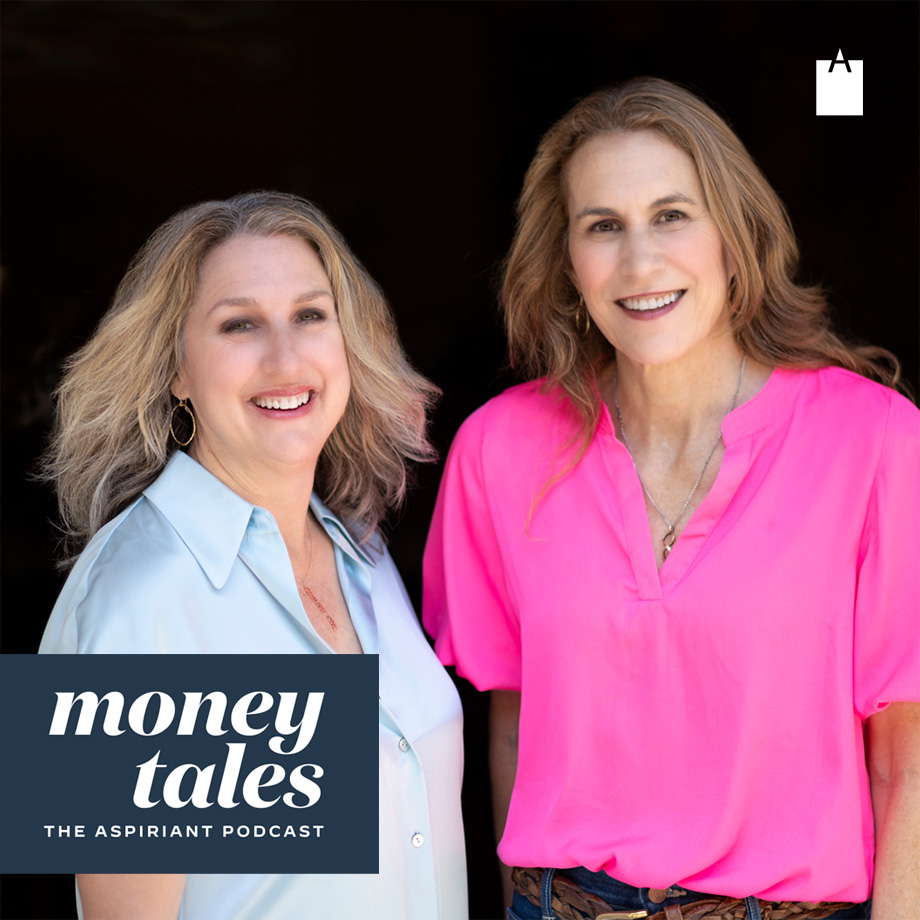
with Sandi Bragar and Cammie Doder

with Uma Viswanathan and Johann Berlin
 Talk to us