Talk to us
 Wealth Planning
How Tax-Aware Long-Short Strategies Help Diversify Concentrated Stock




June 25, 2026

On June 12, 2026, SpaceX began trading on Nasdaq under the ticker SPCX, pricing at $135 per share. The offering raised $75 billion at a $1.77 trillion valuation, nearly three times the $25.6 billion Saudi Aramco raised in its record 2019 listing. And SpaceX is not arriving alone. OpenAI and Anthropic, recently valued near $852 billion and $965 billion respectively, are widely expected to pursue public listings, although the timing and terms remain uncertain.
Together, these three companies represent roughly $4 trillion of potential new public equity within a single 18-month window, a scale without modern precedent. But it is worth being precise about what this $4 trillion actually represents.
At IPO, only a small slice of each company trades, so the equity reaching the market in 2026 is just a fraction of that figure. The real supply arrives later, in 2027, when far more of these shares become available for sale.
The question we hear most often is whether this wave is an opportunity or a risk. The answer is potentially both, and the distinction depends on your time horizon.
As Figure 1 shows, leading private companies have seen extraordinary valuation growth, helping explain why this potential IPO wave is attracting so much attention.

In the near term, the answer is most likely yes. Goldman Sachs estimates total U.S. corporate equity issuance in 2026 at roughly $700 billion, about 1% of the Russell 3000 market capitalization and broadly in line with historical norms. Corporate share buybacks exceeding $1 trillion mean net equity supply remains negative even with these listings included.
The structure of the offerings matters too. SpaceX floated only about 4% of its shares, meaning the freely tradable portion (the float) is roughly $75 billion, not the full $1.77 trillion valuation. OpenAI and Anthropic are expected to follow similar structures. In fact, the early dynamic may be the opposite of oversupply. A small float meeting enormous institutional and retail demand can push prices above what fundamentals alone would justify.
The more consequential event for most investors is not the IPO date but the index inclusion calendar.
Nasdaq and FTSE Russell have accelerated their timelines for large listings, allowing certain newly public companies to be added to major indexes much sooner than in the past. For a company the size of SpaceX, that could mean eligibility for the Nasdaq-100 within weeks of its debut, bringing it into many index-tracking portfolios sooner than investors might expect.
Index inclusion matters because funds that track those benchmarks typically need to purchase newly added constituents. When a company has a relatively small public float, that additional demand can influence trading activity and price movements in the early stages of public ownership.
Not all index providers are taking the same approach. S&P Global recently declined to relax key eligibility requirements. As a result, S&P 500 inclusion may take longer and will depend on the company satisfying S&P’s profitability test: positive GAAP net income from continuing operations in the most recent quarter and over the most recent four quarters in aggregate.
The inclusion of large newly public companies will also impact index concentration. The S&P 500 is already at its highest concentration in 50 years, with the largest technology companies representing roughly 38% of total market value. Adding companies of this size will push concentration further, meaning a small group of firms will increasingly drive the returns and the risks of passive portfolios.
IPO lock-ups (agreements that prevent insiders and early investors from selling for a set period) restrict the vast majority of these companies’ shares from trading for roughly a year after listing. SpaceX founder and early investor shares are locked for 366 days, with similar terms anticipated at OpenAI and Anthropic.
When those locks expire in 2027, the supply picture changes meaningfully. Shares held by founders, venture investors, strategic partners and thousands of employees become freely tradable, and history shows lock-up expirations often bring selling pressure as early holders take liquidity.
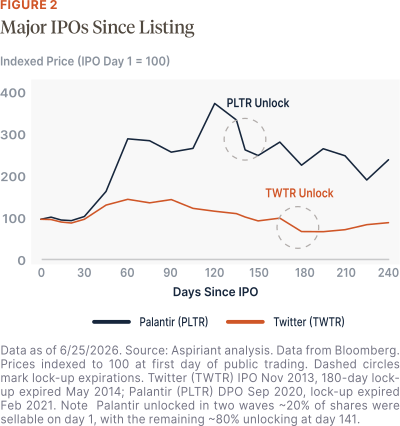
History provides several examples of how large lock-up expirations can affect trading dynamics. As shown in Figure 2, when Twitter (now X) saw its 180-day lock-up expire in May 2014, shares had already run nearly 70% above the IPO price before reversing, falling 18% on expiration day as roughly 480 million insider shares hit the market. Rivian tells a similar story: Amazon and Ford—holding a combined 29%—unlocked simultaneously in May 2022, and the stock dropped another 20% in a single session. Perhaps the most instructive case is Palantir, whose lock-up expired in February 2021 after shares had tripled from their direct listing price. When roughly 1.8 billion shares—approximately 80% of the float—became freely tradable, the stock fell 13% on the day as early investors took liquidity.
That said, not all shares of SpaceX, OpenAI and Anthropic are equally likely to come to market. Although none of these companies discloses a full capitalization table, we estimate that 40% to 50% of shares held by founders, control entities and strategic corporate partners who tend to have strong incentives to hold rather than sell, which should help temper the pace of any post-expiration selling. Sell-side strategists have acknowledged the same point: While 2026 issuance is manageable, the balance of equity supply and demand becomes more challenging in 2027 as expirations accumulate.
In other words, the IPO date is only the starting line. The layering of three mega-cap lock-up expirations in a single year is a supply dynamic the market has little recent precedent for at this scale.
For most diversified investors, no immediate action is required. Passive portfolios will absorb these companies at weights set by index committees rather than by valuation judgment, which reinforces the value of diversification beyond a single index and of active attention to concentration.
For those holding pre-IPO stakes or employee equity in any of these names, the listing marks the beginning of a planning process. Lock-up timing, tax treatment and concentration risk all deserve coordinated attention before shares trade freely. We explore the planning toolkit for concentrated, low-basis positions (from staged selling to tax-efficient diversification) in How to Manage Capital Gains from Concentrated Stock Positions. As always, this is general education, not individualized advice. The right approach depends on your goals, your broader financial picture and what you’re hoping to achieve over the long term.
Markets have absorbed transformative companies before, and diversified portfolios are built precisely for moments when excitement and uncertainty arrive together. Our focus remains on monitoring the index inclusion calendar and early trading behavior while guiding you through a long-term strategy designed to weather both.
We will share more during our July 23 Investing Outlook webinar, where our Investment Strategy and Research team will discuss how the Age of Autonomy is shaping our market views. Clients and invited guests will receive registration details in early July, and a replay will be available on our website soon after the event.



Disclosures
*Source: Aspiriant analysis, data from Morningstar, Bloomberg and the Federal Reserve Economic Database (FRED). U.S. Equities represented by the S&P 500 Index; a market-capitalization-weighted index that includes the 500 most widely held companies chosen with respect to market size, liquidity and industry. U.S. Large Cap Growth and Value Equities represented by the Russell 1000 Growth and Value Indexes; free float-adjusted market capitalization indexes that are designed to track large cap U.S. companies with either Value (lower price-to-book ratios and lower forecasted growth ratios) or Growth (higher price-to-book ratios and higher forecasted growth ratios) characteristics. U.S. Small Cap represented by the Russell 2000 Index, which measures the performance of the small-cap segment of the U.S. equity universe. It is a subset of the Russell 3000 Index representing approximately 10% of the total market capitalization of that index. It includes approximately 2,000 of the smallest securities based on a combination of their market cap and current index membership. U.S. Small Cap Growth and Value represented by the Russell 2000 Growth and Value Indices, which measures the performance of the small-cap growth and value segments of the U.S. equity universe. Global Equities represented by the MSCI ACWI Index; a free float-adjusted market capitalization weighted index that is designed to measure the equity market performance of 23 developed and 26 emerging markets, including the United States. International Equities represented by the MSCI EAFE (Europe, Australasia and Far East) Index; a free float-adjusted market capitalization index that is designed to measure the equity market performance of developed markets excluding the U.S. and Canada. International Large Growth and Value represented by the MSCI EAFE Growth and Value Indexes (Europe, Australasia and Far East); free float-adjusted market capitalization indexes that are designed to measure the equity market performance of large and mid-cap developed markets exhibiting overall growth and value style characteristics, excluding the U.S. and Canada. Emerging Market Equities represented by the MSCI Emerging Markets Index, a free float-adjusted market capitalization index that is designed to measure equity market performance of emerging markets. Municipal Bonds represented by the Bloomberg Municipal Bond Index; an unmanaged index considered representative of the tax-exempt bond market. It consists of a broad selection of investment grade general obligation and revenue bonds of maturities ranging from one to 17 years. Taxable Bonds represented by the Bloomberg U.S. Aggregate Bond Index; a broad-based benchmark measuring investment grade, U.S. dollar-denominated, fixed-rate taxable bonds. No single index represents a benchmark for a globally diversified portfolio. The volatility of an index may be materially different than that of a model. Index returns assume the reinvestment of dividends and capital gains. Private market valuations reflect post-money marks from the most recent primary funding rounds; they are negotiated at a point in time, not audited or marked-to-market, and realized values at IPO may differ materially.
Want the latest wealth management tips, investment insights and Aspiriant news delivered straight to your inbox. Sign up for regular Fathom updates so we can send you the most relevant content you selected below.