Talk to us

Investment Management
AI Investment and Market Diversification




November 20, 2026

Recent volatility in the technology sector, particularly Nvidia, has brought renewed attention to the significant investments being made in artificial intelligence (AI), raising questions about future returns and the sustainability of innovation-driven growth. At the same time, market leadership is broadening beyond a handful of companies, reinforcing the importance of diversification.
Against this backdrop, recent technological disruptions and a shifting political landscape are adding to an already complex investment environment. How should investors interpret these developments, and what do they mean for portfolios? This week’s Quick Takes examines the risks emerging beneath the surface and what investors should consider as markets adjust.
Over the past week, a series of technological failures disrupted some of the systems Americans depend on most. Microsoft experienced a widespread service outage, travelers were stranded by a nationwide aviation shutdown and customers at several major banks encountered difficulties accessing accounts and completing transactions. Coming within days of one another, these service outages surfaced concerns about the vulnerability of the digital infrastructure supporting everyday economic activity.
For investors, the impact extends beyond temporary service disruptions. As businesses increasingly rely on the same cloud providers and technology platforms, operational failures can have ripple effects across industries, potentially affecting revenue, profitability and business continuity. These shared dependencies introduce another form of concentration risk, reinforcing the importance of evaluating business resilience and maintaining diversified portfolios.
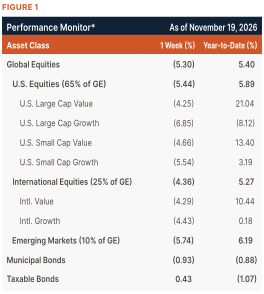
Beyond the recent technology outages, uncertainty surrounding AI, elevated valuations and the outlook for interest rates weighed on markets broadly. Global equities declined -5.3%, bringing year-to-date gains to 5.4%. U.S. equities fell 5.4%, with large-cap value declining -4.3% and large-cap growth -6.9%. Smaller companies also faced pressure, as small-cap value fell -4.7% and small-cap growth dropped -5.5%. International developed equities declined -4.4%, while emerging markets experienced the steepest regional losses, falling -5.7%. Fixed income was mixed, with municipal bonds declining -0.9% and taxable bonds gaining 0.4%.
AI remains one of the most significant drivers of corporate investment and earnings growth. However, the pace of spending raises questions about future profitability, leaving technology shares increasingly sensitive to developments that could challenge investor expectations.
Nvidia sits at the center of this reassessment. The company’s volatility intensified following the departure of longtime CEO Jensen Huang, introducing uncertainty at a critical moment for the semiconductor industry. Even as Nvidia reported quarterly revenue growth exceeding 100% year-over-year, investors are weighing whether the broader AI ecosystem can generate sufficient returns to justify its unprecedented spending, creating a bifurcation between sentiment and fundamentals.
The economic challenge extends beyond semiconductor demand. Technology companies are committing substantial capital to data centers and computing infrastructure, often years before the investments are expected to generate their full returns. Strong demand today supports continued expansion, but the long-term payoff of the AI boom will depend on whether businesses can translate adoption into measurable productivity gains and revenue.
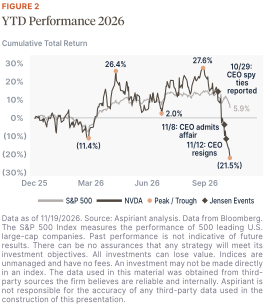
Recent market performance highlights this changing perspective. As shown in Figure 2, Nvidia’s sharp reversal following recent leadership developments has left the stock down -21.5% year-to-date, despite reaching gains of nearly 30% earlier this fall. Meanwhile, the S&P 500 has gained 5.9%, supported by strength elsewhere in the market. With Nvidia accounting for roughly 6% of the index, its decline is significant, but the broader market’s resilience offers reassurance that returns are not dependent on any single company.
The rotation away from concentrated leadership carries important implications for portfolios. After years of tech-driven gains, investors are finding opportunities among value-oriented businesses and companies with more established earnings profiles. So far in 2026, U.S. large-cap value stocks have gained 21.0%, substantially outperforming large-cap growth stocks, which are down -8.1%.
Market leadership can also shift within the technology sector itself. As illustrated in Figure 3, successive waves of innovation can reshape the competitive landscape, as companies that once dominated the industry give way to newer companies. With SpaceX’s recent public debut, Anthropic’s IPO and potential future listings from OpenAI, investors could see another wave of emerging companies challenging established market leaders.
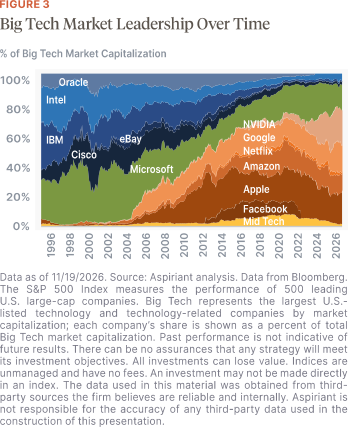
History suggests industries can deliver lasting economic benefits even as competitive pressures alter which companies capture the greatest share of those opportunities. Looking ahead, if broader market participation continues, diversified portfolios may capture more opportunities with less concentration risk.
Midterm election results introduced another noteworthy shift, with Democrats securing control of both chambers of Congress. The resulting divided government could limit the current administration’s ability to pursue additional fiscal stimulus, while increasing scrutiny of technology policy and federal spending. Historically, divided governments have not prevented equity markets from advancing although the legislative outlook may become more complicated as policymakers negotiate competing priorities.
Meanwhile, the U.S. economy remains resilient, supported by a relatively strong labor market and continued business activity. However, persistent inflation has led to speculation of another Federal Reserve rate hike in December. In the coming months, higher interest rates could continue to pressure bond prices and interest-rate-sensitive stocks, even as economic growth remains resilient.
The latest volatility reflects a market adjusting to changing expectations after several years of concentrated leadership. Strong corporate profits continue to provide support, but elevated interest rates and uncertainty around the long-term returns on AI investment may keep valuations under pressure. Encouragingly, market leadership is becoming more balanced and reinforces the benefits of maintaining exposure to multiple sources of return.
As we look ahead, our focus remains on how economic fundamentals develop alongside changing market expectations. For a deeper look at these themes, we encourage readers to explore our latest Q4 2026 Market Outlook Insight, which examines the financial implications of AI investment and the importance of diversification, or watch our Q4 2026 Investing Outlook webinar for additional perspective from Aspiriant’s Investment Strategy & Research team.



Disclosures
*Source: Aspiriant analysis, data from Morningstar, Bloomberg and the Federal Reserve Economic Database (FRED). U.S. Equities represented by the S&P 500 Index; a market-capitalization-weighted index that includes the 500 most widely held companies chosen with respect to market size, liquidity and industry. U.S. Large Cap Growth and Value Equities represented by the Russell 1000 Growth and Value Indexes; free float-adjusted market capitalization indexes that are designed to track large cap U.S. companies with either Value (lower price-to-book ratios and lower forecasted growth ratios) or Growth (higher price-to-book ratios and higher forecasted growth ratios) characteristics. U.S. Small Cap represented by the Russell 2000 Index, which measures the performance of the small-cap segment of the U.S. equity universe. It is a subset of the Russell 3000 Index representing approximately 10% of the total market capitalization of that index. It includes approximately 2,000 of the smallest securities based on a combination of their market cap and current index membership. U.S. Small Cap Growth and Value represented by the Russell 2000 Growth and Value Indices, which measures the performance of the small-cap growth and value segments of the U.S. equity universe. Global Equities represented by the MSCI ACWI Index; a free float-adjusted market capitalization weighted index that is designed to measure the equity market performance of 23 developed and 26 emerging markets, including the United States. International Equities represented by the MSCI EAFE (Europe, Australasia and Far East) Index; a free float-adjusted market capitalization index that is designed to measure the equity market performance of developed markets excluding the U.S. and Canada. International Large Growth and Value represented by the MSCI EAFE Growth and Value Indexes (Europe, Australasia and Far East); free float-adjusted market capitalization indexes that are designed to measure the equity market performance of large and mid-cap developed markets exhibiting overall growth and value style characteristics, excluding the U.S. and Canada. Emerging Market Equities represented by the MSCI Emerging Markets Index, a free float-adjusted market capitalization index that is designed to measure equity market performance of emerging markets. Municipal Bonds represented by the Bloomberg Municipal Bond Index; an unmanaged index considered representative of the tax-exempt bond market. It consists of a broad selection of investment grade general obligation and revenue bonds of maturities ranging from one to 17 years. Taxable Bonds represented by the Bloomberg U.S. Aggregate Bond Index; a broad-based benchmark measuring investment grade, U.S. dollar-denominated, fixed-rate taxable bonds. No single index represents a benchmark for a globally diversified portfolio. The volatility of an index may be materially different than that of a model. Index returns assume the reinvestment of dividends and capital gains. Private market valuations reflect post-money marks from the most recent primary funding rounds; they are negotiated at a point in time, not audited or marked-to-market, and realized values at IPO may differ materially.
Want the latest wealth management tips, investment insights and Aspiriant news delivered straight to your inbox. Sign up for regular Fathom updates so we can send you the most relevant content you selected below.