Talk to us
 Investment Management
Iran Ceasefire Headlines Ease Volatility—What Comes Next?




April 10, 2026

Over the last few weeks, a combination of geopolitical escalation, rising energy prices and renewed questions around the durability of economic growth culminated in the S&P 500’s weakest quarterly performance since 2022.
During this period, a consistent pattern emerged. As oil prices rose, equities moved lower, reflecting concerns that a sustained energy shock could reintroduce inflation pressure, tighten financial conditions and reduce the scope for policy support. That relationship shaped both investor sentiment and positioning as markets moved through quarter-end.
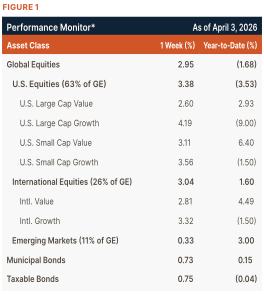
Last week offered some reprieve as equities broke their losing streak and delivered the strongest trading day of the year, suggesting markets may be starting to look through the initial shock and place greater weight on the duration and severity of the disruption. Global equities moved higher, gaining +3.0%; however, returns remain modestly negative year-to-date at -1.7%. Importantly, even with the recent pullback, global equities are still up nearly +25.0% year-over-year, meaning investors who stayed the course participated in one of the strongest one-year periods in recent history.
Gains were not confined to a single segment of the market:
Large-cap equities: Rebounded, with growth outperforming value (+4.2% vs. +2.6%)
Small-cap equities: Advanced, with both styles gaining more than +3.0%
International equities: Rose +3.0%, continuing to provide relative stability year-to-date
Emerging markets: Posted more modest gains of +0.3%
Fixed income: Contributed as well, with municipal and taxable bonds each rising approximately +0.7%
Last week’s rebound serves as a timely reminder that recoveries often begin while uncertainty remains elevated and that the market’s strongest days tend to occur during periods of stress, not after conditions have clearly improved.
Since 2000, missing just 10 of the S&P 500’s best days would have reduced cumulative returns by more than half. These moves rarely coincide with improving headlines, instead arriving while positioning is still defensive and sentiment fragile.
We saw this dynamic as recently as last April, when the S&P 500 delivered roughly 9.5% in a single trading day amid peak volatility. With uncertainty around energy markets and geopolitics still unresolved, that pattern remains relevant today for investors looking to capture long-term returns.
While last week’s recovery was notable, energy markets remain a key anchor for investor sentiment. The path forward will depend on developments in the Middle East, particularly around the Strait of Hormuz, a critical transit point for global energy supply discussed previously in our March Quick Takes. Recent tensions have centered on the stability of flows through the Strait, alongside targeted strikes on regional energy infrastructure.
Ceasefire headlines contributed to a sharp decline in oil prices on Wednesday, reflecting a partial easing of immediate supply concerns. Underlying disruptions, however, remain in place, with key transit routes still constrained and a full recovery expected to take time. Volatility has since eased alongside these developments, with the VIX (CBOE Volatility Index) retracing sharply from recent highs. That said, markets remain highly sensitive to incoming headlines, and until there is greater clarity on a lasting resolution, periods of renewed volatility remain possible.
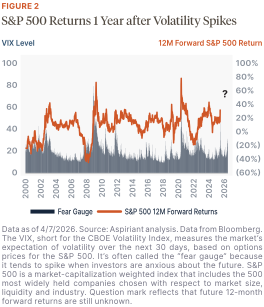
Such uncertainty can feel uncomfortable in real time, but it is also consistent with how market recoveries often begin. As shown in Figure 2, in early April last year the VIX spiked into the mid-40s, yet the S&P 500 went on to return approximately 32% over the following 12 months. While no two periods are identical, the broader pattern is a useful reminder that the moments of greatest discomfort often coincide with improving long-term opportunity.
The near-term outlook will hinge on how incoming data aligns with recent market signals. Last week’s employment report surprised to the upside, reinforcing labor market resilience, while Thursday’s Consumer Price Index (CPI) and Personal Consumption Expenditures (PCE) releases showed consumer spending remained subdued, core inflation remained firm, and headline inflation is beginning to reflect the early pass-through of higher energy prices. With oil prices elevated and shipping conditions through the Strait of Hormuz still evolving, the persistence of inflation will be a key factor in how markets interpret the path for growth and policy.
We’ll walk through how we’re evaluating these developments during our upcoming Investing Outlook webinar on April 30, including how they’re shaping portfolio positioning for the balance of the year. We invite you to join our Investment Team, who will share their perspective.
*Source: Aspiriant analysis, data from Morningstar, Bloomberg, and the Federal Reserve Economic Database (FRED).
U.S. Equities represented by the S&P 500 Index; a market-capitalization-weighted index that includes the 500 most widely held companies chosen with respect to market size, liquidity and industry. U.S. Large Cap Growth and Value Equities represented by the Russell 1000 Growth and Value Indexes; free float-adjusted market capitalization indexes that are designed to track large cap U.S. companies with either Value (lower price-to-book ratios and lower forecasted growth ratios) or Growth (higher price-to-book ratios and higher forecasted growth ratios) characteristics. U.S. Small Cap represented by the Russell 2000 Index, which measures the performance of the small-cap segment of the U.S. equity universe. It is a subset of the Russell 3000 Index representing approximately 10% of the total market capitalization of that index. It includes approximately 2,000 of the smallest securities based on a combination of their market cap and current index membership. U.S. Small Cap Growth and Value represented by the Russell 2000 Growth and Value Indices, which measure the performance of the small-cap growth and value segments of the U.S. equity universe. Global Equities represented by the MSCI ACWI Index; a free float-adjusted market capitalization weighted index that is designed to measure the equity market performance of 23 developed and 26 emerging markets, including the United States. International Equities represented by the MSCI EAFE (Europe, Australasia, and Far East) Index; a free float-adjusted market capitalization index that is designed to measure the equity market performance of developed markets excluding the U.S. and Canada. International Large Growth and Value represented by the MSCI EAFE Growth and Value Indexes (Europe, Australasia and Far East); free float-adjusted market capitalization indexes that are designed to measure the equity market performance of large and mid-cap developed markets exhibiting overall growth and value style characteristics, excluding the U.S. and Canada. Emerging Market Equities represented by the MSCI Emerging Markets Index, a free float-adjusted market capitalization index that is designed to measure equity market performance of emerging markets. Municipal Bonds represented by the Bloomberg Municipal Bond Index; an unmanaged index considered representative of the tax-exempt bond market. It consists of a broad selection of investment grade general obligation and revenue bonds of maturities ranging from one to 17 years. Taxable Bonds represented by the Bloomberg U.S. Aggregate Bond Index; a broad-based benchmark measuring investment grade, U.S. dollar-denominated, fixed-rate taxable bonds. No single index represents a benchmark for a globally diversified portfolio.
The volatility of an index may be materially different than that of a model. Index returns assume the reinvestment of dividends and capital gains.
Want the latest wealth management tips, investment insights and Aspiriant news delivered straight to your inbox. Sign up for regular Fathom updates so we can send you the most relevant content you selected below.