Talk to us
 Investment Management
A Closer Look at Private Credit Pressures




March 27, 2026

Rising default concerns, tighter liquidity and growing scrutiny are prompting investors to take a closer look at the risks embedded in their private credit allocations
Private credit, described as privately negotiated lending not traded through public markets, has become a popular source of income, but recent headlines are beginning to challenge some of the key assumptions underpinning the asset class. Investors are increasingly asking more pointed questions: Is private credit actually safe? Why are some funds limiting withdrawals or restricting access to capital? And what do concerns around AI, software lending and liquidity actually mean for investors?
These questions are valid and make sense. Private credit has grown rapidly into a $2 trillion market globally, and that rapid expansion has brought increased scrutiny around borrower quality, underwriting standards and liquidity. Fortunately, the recent pressure still appears siloed rather than systemic. The important distinction today is between isolated areas of strain and broad conclusions about private credit as a whole.
For many investors, the most immediate concern is liquidity. Some vehicles offering periodic liquidity have faced redemption demand above what they were designed to meet in a given period (~5%). That does not necessarily mean the underlying loans are impaired, but it can still be unsettling for investors who expect more flexibility. For those who own private credit through interval funds, non-traded vehicles or other structures with limited redemption windows, the redemption features designed to protect against rapid shifts in sentiment may become frustrating.
At the same time, borrowers who rely on private credit as a primary source of capital are still adjusting to the aftereffects of the 2022-2023 hiking cycle. Because many private credit loans are floating rate, higher base rates fed through quickly to borrowers. Even after some easing, financing costs remain high enough to pressure more vulnerable companies and make refinancing more difficult. While private credit is not broadly unsafe, the gap between stronger and weaker borrowers is becoming easier to see.
Investors are also paying closer attention to signs of strain that may not show up immediately in headline default rates. These can include payment flexibility, maturity extensions, covenant amendments and other loan modifications that give borrowers more room. On their own, these measures do not necessarily signal trouble. But when they become more common, they can suggest that some borrowers are operating under greater pressure than formal default data alone would imply.
As private credit has grown, and direct lending in particular has scaled, underwriting standards, deal structures and manager discipline have become less consistent. That variation is becoming easier to see as conditions tighten, which is why broad conclusions about private credit are often less useful than understanding the specific strategy, structure and manager involved. It is also important to distinguish today’s pressure from the kind of bank-driven contagion that defined the global financial crisis. Many private credit vehicles are not designed for daily liquidity, which can reduce the risk of forced selling when sentiment shifts quickly. Even so, the market’s growing links to banks, insurers and other parts of the financial system are still worth monitoring.
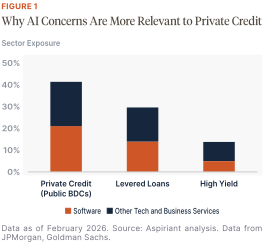
AI adds another layer of concern for private credit investors that is more relevant for some strategies than others. As Figure 1 shows, parts of private credit appear to have greater exposure than leveraged loans or high yield to businesses that may be more vulnerable to AI-related disruption, particularly software and business services. For investors, the key question is not simply how much exposure they have to software, but whether the borrowers’ cash flows are resilient enough to support the loan through a period of faster technological change.
Public BDCs, or business development companies, are publicly traded lenders to middle-market businesses whose disclosures offer a more transparent window into portfolio composition than most semi-illiquid private credit funds. They are not a perfect stand-in for interval funds or other semi-illiquid private credit vehicles, but they can still serve as a useful analog. Viewed collectively, they suggest that software and business services can account for roughly 40% of aggregate exposure in some private credit portfolios, while strategy-level exposure ranges from low single digits to more than 50%. That explains why AI-related risk is highly relevant for some private credit investors, but less so for others.
Private credit spans a wide range of strategies, borrower types, structures and risk profiles. Accordingly, outcomes and realized returns can differ significantly even within the same broad strategy.
Within direct lending alone, risk can vary based on leverage, documentation, sponsor support, sector exposure and the reason the loan was made. Scale matters as well. As private credit has grown, competition has generally been more intense at the larger end of the market, where lenders often compete more directly with syndicated markets and documentation can become looser. By contrast, the lower middle market has often preserved stronger lender protections, including more frequent maintenance covenants, though that advantage should not be treated as absolute. Sponsor-backed and non-sponsor lending can also behave differently. Sponsor-backed deals boast more institutional reporting, tighter lender coordination and the potential for sponsor support in a workout scenario. Non-sponsor deals may offer better economics or stronger structuring in some cases, but they can also involve more company-specific execution risk and require more lender skill. Asset-backed lending can introduce another layer of differentiation, with repayment tied more directly to underlying collateral and cash flow pools than to the enterprise value of a single corporate borrower.
Broad headlines can be misleading. A useful question is not whether private credit is safe, but which part of the market an investor owns, how the investment is structured and whether the risks are being adequately compensated.
Recent headlines deserve attention, but they do not justify treating all private credit the same. The prudent approach is to look past the label and focus on borrower quality, liquidity terms, underwriting discipline and manager selectivity. While this may be the first meaningful liquidity test for many semi-illiquid private credit strategies, it is not the first time investors have confronted similar questions in private markets. Private real estate structures – including REITs and ODCE funds – have faced periods of liquidity pressure in recent history, and in many cases outcomes depended less on the headlines than on the quality of the underlying assets and the discipline of the manager. While history is not a blueprint, it does offer an important reminder: in a market this large and varied, broad generalizations are rarely helpful. For investors with exposure to private credit, this may be a useful moment to revisit how their strategies are structured, where the underlying risk sits and whether the expected return still matches the liquidity and credit risks involved.
Want the latest wealth management tips, investment insights and Aspiriant news delivered straight to your inbox. Sign up for regular Fathom updates so we can send you the most relevant content you selected below.