Talk to us
 Investment Management
Iran Ceasefire Headlines Ease Volatility—What Comes Next?




March 13, 2026

Initially, investors appeared willing to look through the headlines. But as conflict in the Middle East intensified late last week and global oil prices climbed, markets began to reflect the potential economic consequences more directly.
The latest escalation is part of a long-running conflict tied to Iran’s nuclear program and its influence across the Middle East. While geopolitical tensions frequently capture headlines, markets typically react most strongly when those events threaten the global energy supply system, where the region plays an outsized role.
The Middle East produces roughly one-third of the world’s oil and sits along several of the most important shipping routes for global energy. In particular, the Strait of Hormuz serves as a critical transit point for global oil shipments, with roughly 20% of the world’s oil supply passing through it each day. As hostilities intensified and shipping routes faced new constraints, crude oil prices moved higher, raising concerns that a prolonged disruption could push energy prices up further.
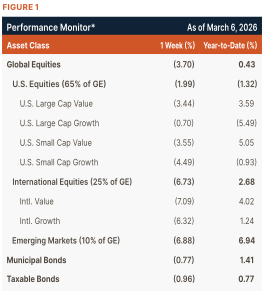
As shown in Figure 1, global equities declined -3.7%, erasing much of the year’s gains. U.S. stocks proved more resilient, falling -2.0%. However, beneath the surface, performance varied meaningfully. Smaller companies experienced the largest declines, with U.S. small-cap growth down -4.5% and small-cap value falling -3.6%. Among larger companies, value stocks declined -3.4%, while growth slipped -0.7%. Despite experiencing a relatively muted decline last week, large-cap growth remains the weakest-performing asset class year-to-date, reflecting pressure from investors reassessing valuations and the pace of AI-related capital spending.
International markets reacted more sharply to the cross-border conflict escalations. Developed international equities fell -6.7%, with both value and growth segments declining by more than 6%. Emerging markets also dropped -6.9%, though they remain among the strongest performers year-to-date, up nearly +7%.
Fixed income markets offered limited relief during the week. Municipal bonds declined -0.8% and taxable bonds fell -1.0%. Periods driven by energy-related inflation can pressure both stocks and bonds simultaneously, particularly when investors are trying to determine how persistent higher energy prices might be. Even so, both bond sectors remain positive for the year, continuing to provide income and diversification within balanced portfolios.
The underlying macro linkage between geopolitical conflict and financial markets is largely centered on energy prices. The Middle East remains a critical hub for global oil supply, and disruptions in the region can ripple quickly through the global economy. Historical modeling suggests that every 10% increase in oil prices tends to reduce global growth by roughly 0.1% while lifting global inflation by about 0.2%. In a more severe disruption scenario, crude oil prices could rise above $125 per barrel. Such a move could translate into roughly a 1% drag on global economic output and a 1.2% increase in headline inflation. Even before accounting for potential valuation pressures from higher interest rates, the earnings implications for equity markets could be meaningful.
Despite these risks, several factors may help prevent a more severe market reaction. Investors often treat these geopolitical shocks as temporary disruptions unless clear evidence emerges that they will meaningfully alter the long-term economic outlook. There are political and economic incentives on all sides of the conflict that favor swift resolution. Energy price spikes are broadly destabilizing, creating pressure for rapid de-escalation among both producers and consumers.
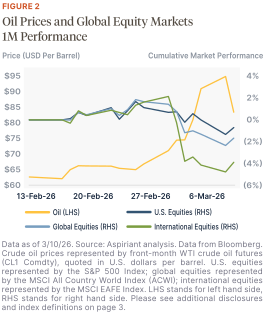
Indeed, markets quickly responded to indications tensions might ease. Late Monday, equities rebounded sharply after President Trump suggested the conflict could be nearing its conclusion, noting that the opposing forces had already lost significant operational capacity. Those comments helped drive crude oil prices lower and lifted global equities roughly 3% from intraday lows by the end of the trading session, as illustrated in Figure 2.
While geopolitical headlines have dominated the news cycle, our team continues to monitor the economic data shaping market outlook. As discussed in our previous Quick Takes, recent employment figures pointed to a labor market that is gradually cooling, and the latest data appears to reinforce that trend. This week’s inflation reports offered additional insight into price pressures. The Consumer Price Index (CPI) came in largely flat relative to the prior month, while the Personal Consumption Expenditures (PCE) Index ticked modestly higher. Taken together, the data suggests inflation pressures remain relatively contained. These readings will help shape expectations for how policymakers approach interest rate decisions next week.
Having guided families through many market cycles, we’ve seen that markets often process geopolitical developments more gradually than the news cycle suggests. Periods like this remind investors that many forces simultaneously shape the investment landscape, from energy prices and global politics to corporate earnings and domestic economic trends.
While near-term volatility may persist, diversified portfolios are designed to navigate these crosscurrents. Our focus remains on monitoring these developments closely and helping clients stay grounded in their long-term strategy to ultimately drive investment success.
Source: Aspiriant analysis, data from Morningstar, Bloomberg, and the Federal Reserve Economic Database (FRED).
*U.S. Equities represented by the S&P 500 Index; a market-capitalization-weighted index that includes the 500 most widely held companies chosen with respect to market size, liquidity and industry. U.S. Large Cap Growth and Value Equities represented by the Russell 1000 Growth and Value Indexes; free float-adjusted market capitalization indexes that are designed to track large cap U.S. companies with either Value (lower price-to-book ratios and lower forecasted growth ratios) or Growth (higher price-to-book ratios and higher forecasted growth ratios) characteristics. U.S. Small Cap represented by the Russell 2000 Index, which measures the performance of the small-cap segment of the U.S. equity market. It is a subset of the Russell 3000 Index representing approximately 10% of the total market capitalization of that index. It includes approximately 2,000 of the smallest securities based on a combination of their market cap and current index membership. U.S. Small Cap Growth and Value represented by the Russell 2000 Growth and Value Indices, which measures the performance of the small-cap growth and value segments of the U.S. equity universe. Global Equities represented by the MSCI ACWI Index; a free float-adjusted market capitalization weighted index that is designed to measure the equity market performance of 23 developed and 26 emerging markets, including the United States. International Equities represented by the MSCI EAFE (Europe, Australasia, and Far East) Index; a free float-adjusted market capitalization index that is designed to measure the equity market performance of developed markets excluding the U.S. and Canada. International Large Growth and Value represented by the MSCI EAFE Growth and Value Indexes (Europe, Australasia and Far East); free float-adjusted market capitalization indexes that are designed to measure the equity market performance of large and mid-cap developed markets exhibiting overall growth and value style characteristics, excluding the U.S. and Canada. Emerging Market Equities represented by the MSCI Emerging Markets Index, a free float-adjusted market capitalization index that is designed to measure equity market performance of emerging markets. Municipal Bonds represented by the Bloomberg Municipal Bond Index; an unmanaged index considered representative of the tax-exempt bond market. It consists of a broad selection of investment grade general obligation and revenue bonds of maturities ranging from one to 17 years. Taxable Bonds represented by the Bloomberg U.S. Aggregate Bond Index; a broad-based benchmark measuring investment grade, U.S. dollar-denominated, fixed-rate taxable bonds. No single index represents a benchmark for a globally diversified portfolio.
*The volatility of an index may be materially different than that of a model. Index returns assume the reinvestment of dividends and capital gains.
Want the latest wealth management tips, investment insights and Aspiriant news delivered straight to your inbox. Sign up for regular Fathom updates so we can send you the most relevant content you selected below.