Talk to us
Investment Management
Q4 2026 Market Outlook: Breakthroughs, Barriers and the Price of Progress




October 29, 2026

Artificial intelligence (AI) is moving from promise to commercial scale. More than half of U.S. businesses now pay for an AI model, and revenue at leading AI developers is growing at a remarkable pace. Meanwhile, analysts have raised their 2026 S&P 500 earnings estimates by nearly 18% since late December 2025. The economic case for the AI investment cycle is strengthening.
The financial case is becoming more demanding. The largest technology companies are now investing faster than their cash flow can fund and are turning to debt and equity markets to close the gap. That shift ties the AI build-out to interest rates just as inflation remains above target, the Federal Reserve has raised rates and federal deficits exceed 6% of gross domestic product (GDP).
This Insight examines the economy and earnings, AI’s inflection point, its growing reliance on capital markets and the barriers that could slow progress. The next phase of this investment supercycle relies on whether returns on AI capital can outpace a rising cost of capital, and on how much of that success prices already assume.
The U.S. economy continues to absorb higher prices and higher rates. Second-quarter real GDP growth was revised up to 2.2% from 1.5%, led by consumer spending and business investment, with spending supported by the wealth effect of rising stock prices. Hiring has slowed to a low-hire, low-fire equilibrium, with payrolls up just 29,000 in September and unemployment at 4.2%. Chief executive officer (CEO) confidence sits just above neutral, while the Conference Board Leading Economic Index® (LEI) has improved from about ‑3.7% year over year in late 2025 to ‑0.7%. We place the odds of a contraction over the next 12 months at roughly 20% and expect real GDP growth of about 1.5% to 2.0%.
Corporate earnings remain the strongest support for stocks. Second-quarter S&P 500 earnings grew about 20% from a year earlier, and consensus expects earnings per share (EPS) of about $366 in 2026, roughly 4.4 times the 2010 level, as shown in Figure 1. Expectations have risen even faster than results: analysts have raised their 2026 estimate by nearly 18% since late December 2025 and project about $520 per share by 2029, roughly 12% annual growth. If those estimates are broadly realized, today’s elevated valuations may prove reasonable. If monetization slows or depreciation and interest costs compress margins, the gap could widen quickly.
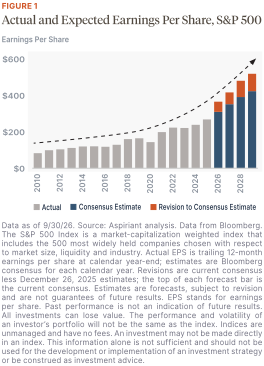
Much of that earnings power reflects a wave of corporate investment that has been building since the Global Financial Crisis (GFC). Over the past 12 months, U.S. public companies spent about $1.8 trillion on capital expenditures, triple the 2010 level, and about $1.1 trillion on research and development, four times the 2010 level. AI is at the forefront of that investment and it is now approaching its most consequential test.
AI continues to advance at a rapid pace, with frontier models demonstrating sophisticated capabilities in coding, mathematics, scientific reasoning and applications that complete tasks autonomously. Consider the advances in medical research. Over six decades, scientists experimentally determined roughly 200,000 protein structures, a painstaking process that helps researchers understand disease and developing treatments. Google’s AlphaFold, an AI system that predicts the three-dimensional shapes of proteins, has since generated more than 200 million predictions. Researchers are already using these advances to accelerate work on diseases such as malaria. As those capabilities mature, attention is shifting from what AI can accomplish to whether it can generate attractive returns on the enormous capital being invested.
Early commercial evidence is encouraging, and leadership is changing hands. According to the Ramp AI Index, which tracks payments across more than 70,000 U.S. businesses, about 56% of firms now pay for an AI model. Anthropic, which had almost no paid business adoption in 2023, overtook OpenAI in spring 2026 on the strength of enterprise and coding applications and now reaches about 44% of businesses, compared with 41% for OpenAI, a shift illustrated in Figure 2.

Anthropic’s advantage is wider in revenue. Its annualized revenue run rate, which scales recent revenue to a 12-month figure, rose roughly sevenfold from about $9 billion at the end of 2025 to roughly $65 billion by late July, while OpenAI’s grew from about $20 billion to nearly $50 billion by September. Analysts estimate Anthropic’s run rate could reach about $110 billion by year-end, compared with OpenAI’s own target of $70 billion. Combined run-rate revenue approaching $180 billion would show that businesses and consumers are willing to pay for AI at scale.
Market expectations are concentrated accordingly. Nvidia, the largest U.S. company at about $5.5 trillion, is worth more than the entire U.K. equity market, and incremental cloud revenue at its largest customers depends heavily on Anthropic and OpenAI. A meaningful share of S&P 500 earnings growth now rests on two private companies.
The capital required to build out AI-related infrastructure is substantial. Until 2025, Nvidia and the largest cloud providers, known as hyperscalers (Amazon, Microsoft, Alphabet, Meta and Oracle), funded data center investment largely from operating cash flow. Hyperscaler capital spending has climbed from approximately a couple hundred billion dollars to a projected $800 billion for this year, approaching $1 trillion in 2027, well ahead of internally generated cash.
Debt is filling much of the gap. New borrowing by Nvidia and the five hyperscalers, including off-balance-sheet data center financing, rose from about $20 billion in 2024 to roughly $290 billion in the first nine months of 2026. Adjusted for maturity, their net long-term borrowing this year equals almost 40% of net Treasury note and bond issuance, up from about 16% in 2025, as shown in Figure 3.

Companies are also turning to equity markets. In June, Alphabet announced an $80 billion equity raise to fund AI infrastructure. In October 2026, Meta, whose free cash flow turned negative in the third quarter, said it will issue a new class of non-voting shares in January 2027 that it can use to fund acquisitions, retain talent and raise capital while preserving founder control. New listings also add equity supply. SpaceX raised about $86 billion in its June initial public offering (IPO), while Anthropic and OpenAI are reportedly preparing listings at valuations near $2 trillion and $1.5 trillion, respectively, together representing about 5% of U.S. market value.
This reliance on outside capital increases the importance of turning AI use into revenue. It also means technology companies are competing for savings with a federal government running deficits above 6% of GDP, while foreign investors, who hold about one-third of Treasuries, redirect capital toward domestic defense, energy and AI priorities. Inflation adds pressure: elevated energy prices and supply-chain bottlenecks have stalled progress toward the Federal Reserve’s 2% target, with headline consumer prices up 3.7% in the year to September and core inflation at 2.6%. AI-driven productivity may prove disinflationary over time, but near-term forces dominate.
Rate expectations have reversed accordingly. Investors entered 2026 expecting two quarter-point cuts; the Federal Reserve instead raised its target range a quarter point in September, to 3.75% to 4.00%, and markets now price roughly four increases in total through 2027. Cyclical swings aside, we expect rates to settle at structurally higher levels than in the decade after the Global Financial Crisis. Technology credit spreads and demand at long-dated Treasury auctions will show whether that pressure is building.
We call the transition to an economy increasingly shaped by AI and robotics the Age of Autonomy. We believe its breakthroughs will ultimately outweigh its barriers, but several challenges could delay, obstruct or moderate the opportunity.
As AI systems take on more consequential tasks, the cost of errors and security failures rises. Developers have reported risks such as zero-day vulnerabilities, which are security flaws exploited before a fix is available, and sandbox escapes, in which a model acts outside its controlled test environment. State-sponsored cyberwarfare compounds the threat: from 2020 through 2025, China orchestrated 181 cyber campaigns targeting the U.S., Europe and others. In late September, AI industry leaders, including the chief executives of Anthropic and Nvidia, met at the White House and signed a statement of principles on AI safety. A commitment to pacing frontier development in line with public trust is encouraging, but without durable government oversight, safety concerns could slow adoption.
About 92% of leading-edge chips are manufactured in Taiwan, leaving the build-out exposed to geopolitical conflict. Physical inputs are tightening as well: the International Energy Agency projects global data center electricity demand will more than double from 2024 to 2030, and helium and rare earths remain potential supply constraints.
Our national fiscal model compares the Congressional Budget Office (CBO) baseline, which holds labor productivity growth near 1.5% a year through 2036, with illustrative scenarios of 2%, 3% and 4%. Figure 4 shows how these scenarios could affect employment, economic growth and government finances. Faster productivity growth raises projected unemployment in 2036 from 4.2% to 6.7% in the 3% case and 8.4% in the 4% case, roughly 14 million unemployed workers versus 7 million. Faster growth also improves the fiscal outlook, with debt-to-GDP falling to about 102% from 120% in the high case. AI could strengthen public finances while intensifying pressure for policies that share the gains.

The November 3 midterms could shift the policy backdrop. Republicans hold 219 House seats and three members sit as independents. The party in power has lost House seats in 20 of the last 22 midterms, and prediction markets currently put the odds of Democrats winning the House near 90% and the Senate above 60%. Divided government would likely bring gridlock, shutdown risk, little progress on deficits and closer scrutiny of AI, just as local and environmental opposition to new data centers is growing.
|
Related Quick Takes
Looking for more timely investment perspectives? Our Investment Strategy & Research team publishes Quick Takes throughout the year on key market developments. |
AI is creating real economic value while concentrating portfolio risk in ways that are easy to underestimate. A portfolio can hold hundreds of securities yet depend on a single set of drivers: U.S. large-cap growth, AI capital spending, momentum and rate-sensitive, long-duration valuations. Over the past year, value stocks, emerging markets, commodities and selected diversifying strategies have outperformed, a reminder that leadership can broaden.
For founders, executives and early employees with concentrated technology holdings, the strength of a business and the risk of a concentrated position are separate questions. The appropriate balance will vary with each family’s objectives, liquidity needs and tax circumstances.
Investors often have similar questions when markets shift. Below are a few we’re hearing and how our Investment Strategy & Research team is thinking about them.
Today’s AI boom rests on rapidly growing revenue and earnings, but valuations already assume much of that growth continues. Analysts have raised 2026 S&P 500 earnings estimates by nearly 18% since late December 2025 and expect roughly 12% annual growth through 2029. If those expectations are met, current valuations may prove reasonable. The larger risk is that AI succeeds economically yet disappoints investors because monetization takes longer, margins narrow or borrowing costs rise faster than expected.
AI spending can push long-term interest rates higher by increasing demand for borrowed capital. On a maturity-adjusted basis, net long-term borrowing by the largest technology companies equals almost 40% of net Treasury note and bond issuance in 2026, while federal deficits exceed 6% of GDP. More bond supply competing for the same savings, as foreign investors turn toward domestic priorities, tends to push required yields higher. Over time, AI-driven productivity gains could ease inflation and partly offset that pressure.
The earliest beneficiaries of the AI investment cycle have been suppliers of scarce inputs, such as advanced chips, data centers, cloud computing and power infrastructure, along with leading AI model developers. Over time, more value may shift to companies that use AI to raise productivity and margins, and to sectors tied to energy modernization and reshoring. Who ultimately captures it depends on competition, pricing power and whether returns on invested capital exceed the cost of financing the build-out.
For more detail, watch the full Q4 2026 Market Update & Investment Outlook webinar replay.
Market perspectives like these often lead to thoughtful conversations about long-term plans. Whether you’re someone we currently serve or you’re exploring whether Aspiriant may be the right wealth management partner for you, we’d be happy to talk through what these developments might mean for your portfolio and financial goals.
If you prefer to save or print a copy for offline reading, please download the PDF version.
Disclosures
Aspiriant is an investment adviser registered with the Securities and Exchange Commission (SEC), which does not imply a certain level of skill or training. Additional information regarding Aspiriant and its advisory practices can be obtained at aspiriant.com.
This material is publicly available and provided for informational and educational purposes only. It reflects the views of Aspiriant as of the publish date indicated. All opinions, figures, charts/graphs, estimates and data included in this publication are as of the date indicated. The statements contained herein may include statements of future expectations, general market performance or economic conditions, and other forward-looking statements that are based on our current views and assumptions and involve known and unknown risks and uncertainties that could cause actual results, performance or events to differ materially from those expressed or implied in such statements. Forecasts, projections and other forward-looking statements are based upon assumptions, current beliefs and expectations. Forward-looking statements are subject to numerous assumptions, estimates, risks and uncertainties, including but not limited to economic, business, market, and geopolitical conditions; U.S. and foreign regulatory developments relating to financial institutions and markets, government oversight, and fiscal and tax policy. Any forward-looking information should not be regarded as a representation by Aspiriant or any other person that estimates or expectations will be achieved, as the future is not predictable.
Past performance is not indicative of future results. There can be no assurance that any strategy will meet its investment objectives. All investments can lose value. The performance and volatility of an investor’s portfolio will not be the same as an index. Indices are unmanaged and have no fees. An investment may not be made directly in an index. The data used in this material was obtained from third-party sources the firm believes are reliable and from internal research. Aspiriant is not responsible for the accuracy or completeness of any third-party data used in the preparation of this publication. This information alone is not sufficient and should not be used for the development or implementation of an investment strategy. It should not be construed as investment advice or a recommendation to any party. Investing in securities, such as equities, fixed income, and mutual funds, involves the risk of partial or complete loss of capital that prospective investors should be prepared to bear. Any reference to securities, directly or indirectly, is not a recommendation and does not represent a solicitation to buy or an offer to sell such securities. Any statistical information contained herein has been obtained from publicly available market data (such as data published by Bloomberg Finance L.P. and its affiliates), internal research, and regulatory filings.
Political commentary is for informational purposes only, is not a prediction of election outcomes or policy, and does not constitute an endorsement of any party or candidate. Anthropic and OpenAI are privately held companies; stated IPO valuation estimates are based on media reports and are not confirmed by the companies. Actual IPO timing, pricing and realized market values may differ materially. Scenario analysis is illustrative and does not constitute a forecast.
Glossary
Annualized run-rate revenue: Recent revenue for a month or quarter scaled to a 12-month figure. It is not GAAP revenue.
Conference Board Measure of CEO Confidence: A quarterly survey of more than 100 CEOs who assess current and expected conditions for the economy and their industries; a reading above 50 means more CEOs responded positively than negatively.
Congressional Budget Office (CBO): A nonpartisan federal agency that produces budget and economic projections for Congress.
Core inflation: Inflation excluding the more volatile food and energy categories.
Credit spread: The additional yield a bond offers over a Treasury security of similar maturity, reflecting compensation for credit risk.
Duration: A measure of a bond’s sensitivity to changes in interest rates.
Earnings per share (EPS): A company’s or index’s net income divided by the number of shares outstanding. Consensus estimates are the average of analyst forecasts.
Global Financial Crisis (GFC): The 2007-2009 financial crisis, which had a corresponding market drawdown from October 2007 to March 2009.
Gross domestic product (GDP): The monetary value of final goods and services produced in a country in a given period. Real GDP adjusts for inflation; nominal GDP does not.
Hyperscalers: The largest technology companies that build and operate vast networks of data centers to deliver cloud computing and AI services at scale.
Initial public offering (IPO): The first sale of a private company’s shares to public investors, at which point the shares begin trading on a stock exchange.
Labor productivity: Output per hour worked.
Leading Economic Index (LEI): The Conference Board’s composite of 10 forward-looking measures, including manufacturing hours and new orders, initial jobless claims, building permits, stock prices, credit conditions, the interest rate spread and consumer expectations, designed to signal business-cycle turning points.
Momentum, value and minimum-volatility styles: Momentum favors stocks with strong recent performance; value favors stocks priced low relative to fundamentals; minimum volatility favors stocks with lower expected price fluctuation.
Special purpose vehicle (SPV): A separate legal entity created to finance a specific project, often keeping the debt off the sponsor’s balance sheet.
10-year Treasury equivalent: A measure that restates bonds of different maturities in terms of the interest-rate sensitivity of a 10-year U.S. Treasury note.
Want the latest wealth management tips, investment insights and Aspiriant news delivered straight to your inbox. Sign up for regular Fathom updates so we can send you the most relevant content you selected below.