Talk to us
 Wealth Planning
Qualified Small Business Stock (QSBS): Tax Benefits, Rules & Planning Strategies


January 15, 2026

It was a tense start to the year for investors tracking global news. A cluster of developments, from headlines around Venezuelan leadership to renewed focus on Greenland’s strategic importance, had many individuals and families we serve asking for context.
On January 3, a complex operation resulted in Venezuelan President Nicolás Maduro being captured and transported to the United States to face longstanding federal charges, with interim leadership stepping in to assume control amid continued uncertainty about the country’s direction. Investors weighed the potential energy-market implications, given Venezuela sits atop the world’s largest proven oil reserves. Separately, renewed discussion around Greenland’s role in Arctic security has drawn attention not only to diplomatic and defense considerations, but also to implications for shipping routes and resource access.
While this kind of news can feel unsettling, risk assets largely consolidated early-year gains, equity futures climbed and volatility stayed relatively contained. That contrast between intense headlines and steady market behavior helped define the tone for trading into the weekend.
Global equities moved higher, gaining 1.5% for the week and pushing early-year returns just above 2%. U.S. stocks advanced 1.6%, though leadership beneath the surface was more revealing. Within large caps, value outperformed growth, with U.S. large-cap value returning 2.5% compared with a 0.9% gain for large-cap growth, reflecting interest in steadier earnings profiles amid continued AI capital expenditures. The most notable performance came from smaller companies. U.S. small-cap value and growth stocks each rose more than 4% during the week, outpacing larger peers and lifting year-to-date returns above 5%. International developed markets contributed positively, rising 1.4%, while emerging markets gained 1.6%, extending their early-January momentum. In bond markets, municipal bonds outperformed taxable bonds, earning 0.8% and 0.1% respectively, providing steady gains for diversified portfolios.
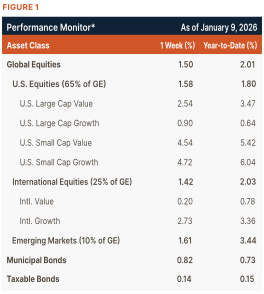
Energy prices were a key backdrop to the week’s developments. Oil futures moved lower even as some energy stocks appreciated, easing concerns that geopolitical events would immediately translate into inflation pressure. For investors, this matters less because of oil itself and more because of what it represents. Lower energy prices reduce strain on consumers and businesses and help keep inflation expectations anchored, an important consideration as markets assess the most likely path of interest rates in 2026.
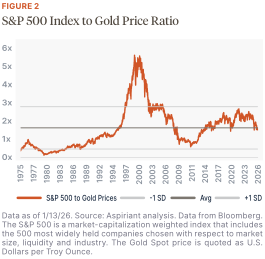
Geopolitical developments also influenced price action across other real assets, most notably gold. Historically, periods of elevated global tension often coincide with sharp moves into perceived “safe havens”. Gold prices have already risen 6% year-to-date, supported by recent headlines and despite gold-backed ETFs such as IAU and GLD being up 70% over the past trailing one-year period, gold does not appear especially stretched when viewed in historical terms relative to the S&P 500.
As shown in Figure 2, the ratio of the S&P 500 to gold remains close to its long-term average, suggesting that gold’s recent strength has been driven more by portfolio risk management than by speculative excess in a market where U.S. stocks remain relatively expensive by historical standards. Today, investors are paying meaningfully more (about 23% more) for each dollar of expected corporate earnings than they typically have over historical standards. Consequently, recent market behavior suggests investors are balancing equity positioning with selective exposure to diversifiers, sorting through global events, economic data and policy signals rather than a single headline.
Recent economic data reinforced signs of an economy in recalibration. Inflation remains broadly in line with expectations, while the labor market continues to cool within a “low hire, low fire” dynamic. Job creation in 2025 was the weakest non-recession year since 2003, as hiring softened and layoffs remained limited amid trade uncertainty, reduced immigration, government layoffs and a shift toward AI-driven investment over labor expansion. While the outlook for 2026 appears favorable, it may not translate into meaningfully faster job growth. Historically, productivity-led expansions support output and earnings growth with more muted employment gains, and the current cycle increasingly resembles that pattern. The upcoming earnings season will test whether profit growth can continue to offset softer hiring trends.
Taken together, the data points to a slower but stable economy, leaving room for additional policy support. The Federal Reserve has already cut interest rates by 75 basis points since September, with the possibility of further easing ahead. Fiscal policy is also expected to provide support. Legislation passed in July includes roughly $200 billion in tax relief for 2026, with average individual refunds projected to rise sharply from last year. Ultimately, the policy mix should provide a cushion as growth moderates. Looking ahead, markets are likely to focus on whether incoming data remains consistent with an economy cooling gradually rather than abruptly.
Headlines are moving faster than data, and clarity is arriving in pieces rather than all at once. Our focus is on tracking those pieces over time, separating what has the potential to reshape outlook from what is more likely to fade. The months ahead will test whether easing inflation, cooling growth and strong earnings can continue to coexist, or whether one begins to dominate.
We’ll explore how we’re making those distinctions during our upcoming Investing Outlook webinar on January 22, where our Investment Team will share how today’s crosscurrents are shaping portfolio decisions. We invite you to register and join the discussion.



Source: Aspiriant analysis, data from Morningstar, Bloomberg, and the Federal Reserve Economic Database (FRED).
*U.S. Equities represented by the S&P 500 Index; a market-capitalization-weighted index that includes the 500 most widely held companies chosen with respect to market size, liquidity and industry. U.S. Large Cap Growth and Value Equities represented by the Russell 1000 Growth and Value Indexes; free float-adjusted market capitalization indexes that are designed to track large cap U.S. companies with either Value (lower price-to-book ratios and lower forecasted growth ratios) or Growth (higher price-to-book ratios and higher forecasted growth ratios) characteristics. U.S. Small Cap represented by the Russell 2000 Index, which measures the performance of the small-cap segment of the U.S. equity universe. It is a subset of the Russell 3000 Index representing approximately 10% of the total market capitalization of that index. It includes approximately 2,000 of the smallest securities based on a combination of their market cap and current index membership. U.S. Small Cap Growth and Value represented by the Russell 2000 Growth and Value Indices, which measures the performance of the small-cap growth and value segments of the U.S. equity universe. Global Equities represented by the MSCI ACWI Index; a free float-adjusted market capitalization weighted index that is designed to measure the equity market performance of 23 developed and 26 emerging markets, including the United States. International Equities represented by the MSCI EAFE (Europe, Australasia, and Far East) Index; a free float-adjusted market capitalization index that is designed to measure the equity market performance of developed markets excluding the U.S. and Canada. International Large Growth and Value represented by the MSCI EAFE Growth and Value Indexes (Europe, Australasia and Far East); free float-adjusted market capitalization indexes that are designed to measure the equity market performance of large and mid-cap developed markets exhibiting overall growth and value style characteristics, excluding the U.S. and Canada. Emerging Market Equities represented by the MSCI Emerging Markets Index, a free float-adjusted market capitalization index that is designed to measure equity market performance of emerging markets. Municipal Bonds represented by the Bloomberg Municipal Bond Index; an unmanaged index considered representative of the tax-exempt bond market. It consists of a broad selection of investment grade general obligation and revenue bonds of maturities ranging from one to 17 years. Taxable Bonds represented by the Bloomberg U.S. Aggregate Bond Index; a broad-based benchmark measuring investment grade, U.S. dollar-denominated, fixed-rate taxable bonds. No single index represents a benchmark for a globally diversified portfolio.
*The volatility of an index may be materially different than that of a model. Index returns assume the reinvestment of dividends and capital gains.
Want the latest wealth management tips, investment insights and Aspiriant news delivered straight to your inbox. Sign up for regular Fathom updates so we can send you the most relevant content you selected below.