Talk to us
 Investment Management
Insight Q2 2026: Market Outlook and Investment Commentary




May 16, 2026

Entering the second quarter of 2026, several forces are shaping markets at once. Geopolitical tensions are contributing to energy market volatility, inflation is continuing to ease but remains sensitive to oil prices and artificial intelligence (AI) is influencing earnings, market leadership, cybersecurity and parts of the credit market.
Despite elevated uncertainty, financial markets have remained relatively resilient, supported by strong corporate fundamentals and expectations that geopolitical disruptions will not develop into a prolonged energy shock. This leaves the economy on firmer footing than many expected. However, the sources of risk and return are still shifting.
This quarter’s Insight builds on themes discussed during our recent Investing Outlook webinar, taking a closer look at the forces we believe will matter most as market conditions continue to evolve.
The conflict in Iran became one of the most important geopolitical developments of early 2026, with implications extending well beyond the Middle East. Beginning in late February, the U.S. carried out joint strikes with Israel aimed at reducing Iran’s capacity to project military power outside its borders, whether through conventional weapons, proxy networks, or its nuclear program. The conflict raised broader questions about regional stability, energy security and global trade routes.
For context, Iran’s economy — valued at roughly $300 billion to $450 billion, depending on oil supply and sanctions — accounts for approximately 1% to 1.5% of U.S. gross domestic product (GDP). But its strategic position is outsized: roughly 20% of the world’s daily petroleum supply, about 20 million barrels, moves through the Strait of Hormuz. Saudi Arabia, Iraq, Kuwait and the United Arab Emirates (UAE) all rely on that passage to deliver oil to China, India, Japan and South Korea. In response to the strikes, Iran effectively closed the strait to non-Iranian-flagged vessels, showing how quickly a regional flashpoint can become a global economic event.
The conflict also reflects broader geopolitical realignment involving major powers such as China and Russia, reinforcing how regional tensions can influence commodity prices, capital flows and investor sentiment. For investors, the market impact is less about any single event and more about how these pressures move through inflation and policy decisions over time.
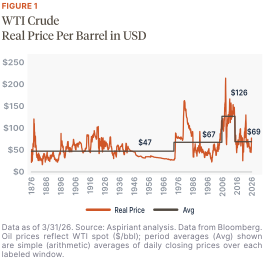
The gap between near-term prices of oil and forward expectations suggests that investors are taking the supply risk seriously but are not yet preparing for a prolonged disruption. As shown in Figure 1, real (i.e., inflation-adjusted) oil prices have moved through long periods of relative stability, interrupted by regime shifts tied to geopolitical events, supply constraints and changes in global demand.
The U.S. position today as a net energy exporter, meaning it produces more energy than it imports, provides some insulation relative to prior oil shocks in the 1970s and early 2000s, when the U.S. relied more heavily on imported energy. That does not eliminate the supply risk, but it helps explain why the economic effect has remained more contained than in prior periods.
Gold, meanwhile, told a different story. Prices reached an all-time high of $5,417 per ounce in late January, supported by years of central bank demand and currency diversification. Since then, gold has softened to roughly $4,706 per ounce, though prices remain near historic highs.
The decline does not appear to reflect reduced geopolitical concern. Rather, higher interest rate expectations seem to have more than offset the perceived safety demand that often supports gold during periods of stress.
Despite gold’s recent decline, it continues to play its intended role as a portfolio diversifier. We view gold more like a currency than a traditional commodity because its value is tied less to industrial demand and more to its role as a store of value. That role can be especially relevant when confidence in major currencies, fiscal discipline or geopolitical stability weakens, helping explain why gold remains an important diversifier in the current environment.
Broader financial markets have, perhaps surprisingly, moved through these crosscurrents with relative composure, supported by otherwise strong corporate fundamentals and continued investment in AI.
Even with oil prices remaining elevated, inflation continues to trend in a positive direction, although the pace of improvement has been more uneven in recent quarters. The core Consumer Price Index (CPI), which excludes more volatile food and energy categories, currently sits near 2.5%. The Federal Reserve’s (the Fed) preferred inflation measure, core Personal Consumption Expenditures (PCE), remains modestly higher at around 3.0%. Five-year breakeven inflation expectations have settled near 2.3%, suggesting financial markets continue to believe the broader disinflation trend remains intact.
The primary risk is energy. Oil prices briefly moved above $120 per barrel earlier this year, following disruptions tied to Iran and the Strait of Hormuz. Higher energy costs can ripple through transportation, manufacturing, packaging and consumer goods, creating broader inflationary pressure across the economy. The U.S. position as a net energy exporter provides some insulation, but it is not a complete buffer.
This creates a more nuanced inflation picture than the headline data suggests alone. Core inflation is easing, but energy-related price pressure can still influence expectations, consumer behavior and corporate margins. Productivity gains from AI may eventually help offset inflation by increasing efficiency and expanding the supply of goods and services, however the timing and scale of those benefits remain uncertain.
The Fed appears to have room to ease policy modestly, though markets have already moved in anticipation of that outcome. The current yield curve sits only slightly above forward rate expectations on both the short and long ends, meaning markets are not anticipating dramatic policy shifts in either direction.
Leadership changes at the Fed are also drawing investor attention. Kevin Warsh has been confirmed as the next Fed chair, succeeding Jerome Powell. At this stage, we view near-term rate decisions as more likely to be driven by inflation, labor-market data and broader financial conditions than by the leadership transition alone.
For long-term investors, this is a relatively stable backdrop for fixed income, with the caveat that energy-related inflation remains an important variable worth watching.
Despite the geopolitical turmoil and bouts of volatility, U.S. equity markets have continued to advance and the fundamentals behind that strength are unprecedented. Of the companies that have reported first-quarter earnings, more than 85% exceeded analyst expectations, well above the historical average of roughly 75%. Full-year 2026 earnings estimates for the S&P 500 now stand at approximately $326 per share, representing 19% growth compared with 2025. Analysts continue to project solid earnings growth in 2027 and 2028, driven in large part by anticipated AI-related efficiency gains.
As shown in Figure 2, consensus earnings expectations for 2026 through 2028 continue to trend higher. The recent upward inflection helps explain why equities remained resilient despite earlier-year volatility. This remains one of the market’s strongest pillars today. Earnings estimates are not merely holding steady; they are being revised upward.
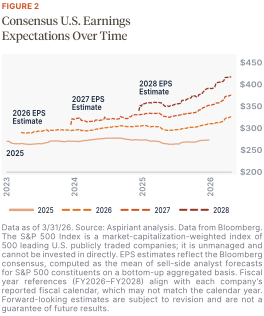
Some investors may wonder whether U.S. equity valuations are too high. A forward price-to-earnings multiple of approximately 21.8 times estimated 2026 earnings is elevated by historical standards, but context matters. If earnings growth continues through 2028 as analysts expect, that multiple falls closer to roughly 17 times earnings on a two-year forward basis, which remains within a normal historical range for a market with strong earnings momentum.
Today’s market reflects optimism, but not the kind of excess that has historically preceded sharp corrections. We are keeping a close eye on valuations, especially as a handful of mega-cap technology companies continue to drive a disproportionate share of market returns. As long as these companies keep delivering strong growth and earnings, investors may continue to justify higher valuations. If these companies miss expectations, the broader index could feel an outsized impact.
The S&P 500 is more concentrated today than at any point in the past 50 years. The largest technology companies collectively represent approximately 35% of the index’s total market capitalization, up from low single digits in 2015. As shown in Figure 3, a small group of technology-oriented companies has driven a growing share of market value over the past decade.
That concentration rewarded index investors during this cycle, but it also means that a handful of companies exert an outsized influence on overall market returns.

Adding to this dynamic is an unprecedented pipeline of large private companies expected to go public in the coming quarters. SpaceX is anticipated to be listed at a valuation of $1.5 trillion or more, a figure comparable to Meta or Tesla. If these companies enter public markets, investors may need to absorb meaningful new supply and the timing of lock-up expirations could influence index performance in the months that follow.
Related Quick Takes
Looking for more timely investment perspectives? Our Investment Strategy & Research team publishes Quick Takes throughout the year on key market developments.
Explore the latest Quick Takes
The same AI capabilities driving productivity gains across the economy are also reshaping cybersecurity threats. State-sponsored cyberattacks have grown significantly in scale and sophistication, with China-attributed incidents representing the largest shares of documented campaigns globally. Between 2000 and 2024, Chinese state or state-affiliated actors carried out attacks targeting more than 218 entities in the United States alone, along with dozens of campaigns targeting Australia, Canada, Taiwan, Japan and other countries.
As shown in Figure 4, the reach of these campaigns is global, but the concentration of attacks against U.S. entities underscores why cyber risk is especially relevant for U.S. businesses, infrastructure and policymakers. Some campaigns lasted years, including one prolific group that remained active for more than 13 years while targeting organizations across more than a dozen countries.
The implications of these risks extend well beyond the technology sector. Critical infrastructure, financial systems and government networks all rely on digital defenses that must adapt as threats evolve. AI is central to that shift because it can both increase the sophistication of attacks and improve the ability to detect vulnerabilities, monitor systems and respond more quickly.
Anthropic’s recently released Mythos model drew significant attention for pushing AI capabilities in cybersecurity. Figure 5 shows Anthropic’s rapid progress across the Epoch Capabilities Index, a benchmark designed to compare general AI model performance across dozens of tests.

The model achieved record results on cybersecurity-related benchmarks, including Anthropic’s CyBench test for identifying and exploiting vulnerabilities. It also outperformed prior models on CyberGym, highlighting how quickly advanced AI systems are improving in both offensive and defensive cybersecurity tasks.
Notably, Mythos has identified real vulnerabilities in widely used software applications that had previously gone undetected, allowing those gaps to be patched before broader deployment.
This dual-use nature of advanced AI is one of the defining technology and security questions facing governments, businesses and investors. The same systems that can identify vulnerabilities and strengthen defenses can also be used to exploit weaknesses more efficiently.
For long-term investors, this is not simply a technology story. It reflects the growing importance of AI across cybersecurity, national security and the evolving risk profile of every sector that depends on digital infrastructure.
Equity markets have advanced and corporate fundamentals remain solid, but tensions remain beneath the surface. Market returns are increasingly concentrated in a narrow set of large technology companies, while energy prices continue to be elevated and geopolitically sensitive. Inflation has eased but has not been fully resolved.
However, these are not reasons to step back from equities. Instead, they reinforce the importance of spreading risk deliberately across asset classes and geographies, rather than allowing recent market leadership to create unintended concentration.
In practice, this may mean holding a globally diversified mix of equities, including meaningful international exposure, while maintaining fixed income exposure across the yield curve without taking outsized duration risk. It also reinforces the role of real assets, including commodities, gold, infrastructure and related exposures, which can serve as portfolio diversifiers in an environment where energy prices and geopolitical uncertainty remain elevated.
Diversification becomes even more important as global cycles become less synchronized. When regions and asset classes respond differently to shifting economic conditions, portfolios can benefit from multiple sources of return rather than depending on a single market or theme. A well-diversified portfolio, managed with patience and discipline, remains one of the most reliable ways to navigate through that uncertainty.
Investors often have similar questions when markets shift. Below are a few we’re hearing from clients and how our Investment Strategy & Research team is thinking about them.
Historically, the party in power tends to lose seats in midterm elections and early indicators suggest 2026 may follow that pattern. If that pattern holds, a Democratic House could bring more legislative gridlock and a higher risk of government shutdowns, while a Democratic Senate could slow key appointments and limit the administration’s ability to advance its agenda. Structural deficits, however, may remain elevated regardless of which party holds power. Figures 6 and 7 show the current congressional balance of power heading into the 2026 election cycle.


While elections can create short-term uncertainty, markets have historically adapted to changing political environments over time. For long-term investors, maintaining diversification and remaining aligned with long-term financial plans generally remains more important than repositioning portfolios around election forecasts.
Private credit remains an important part of diversified portfolios. Much of the recent concern has been focused on retail-oriented vehicles such as business development companies (BDCs) and interval funds, which account for roughly one-quarter of the $1.7 trillion direct lending market and are experiencing elevated redemptions. A key issue is exposure to software and other asset-light technology businesses, where AI tools may pressure growth, margins, or competitive advantages.
Figure 8 shows how software and technology exposure is more pronounced in private credit than in leveraged loans or high-yield bonds, helping explain why recent headlines are concentrated in this part of the credit market. Pressure is also more acute in parts of the upper-market direct lending segment, where underwriting standards became looser as capital flowed into the asset class.

Those pressures appear less evident in lower-middle-market lending, where exposure to software borrowers is generally lower and underwriting standards tend to be tighter.
We recently explored these themes further in our Quick Takes, A Closer Look at Private Credit Pressures.
If you’d like to explore these themes in more detail, we invite you to watch the full Q2 2026 Investment Outlook webinar replay.
Market perspectives like these often lead to thoughtful conversations about long-term plans. Whether you’re someone we currently serve or you are exploring whether Aspiriant may be the right wealth management partner for you, we’d be happy to talk through what these developments might mean for your portfolio and financial goals.
If you prefer to save or print a copy for offline reading, please download the PDF version. Download PDF.
Disclosures
Aspiriant is an investment adviser registered with the Securities and Exchange Commission (SEC), which does not imply a certain level of skill or training. Additional information regarding Aspiriant and its advisory practices can be obtained at aspiriant.com.
This material is publicly available and provided for informational and educational purposes only. It reflects the views of Aspiriant as of the publish date indicated. All opinions, figures, charts/graphs, estimates and data included in this publication are as of the date indicated. The statements contained herein may include statements of future expectations, general market performance or economic conditions, and other forward-looking statements that are based on our current views and assumptions and involve known and unknown risks and uncertainties that could cause actual results, performance or events to differ materially from those expressed or implied in such statements. Forecasts, projections, and other forward-looking statements are based upon assumptions, current beliefs, and expectations. Forward-looking statements are subject to numerous assumptions, estimates, risks, and uncertainties, including but not limited to economic, business, market, and geopolitical conditions; U.S. and foreign regulatory developments relating to financial institutions and markets, government oversight, and fiscal and tax policy. Any forward-looking information should not be regarded as a representation by Aspiriant or any other person that estimates or expectations will be achieved, as the future is not predictable.
Past performance is not indicative of future results. There can be no assurance that any strategy will meet its investment objectives. All investments can lose value. The performance and volatility of an investor’s portfolio will not be the same as an index. Indices are unmanaged and have no fees. An investment may not be made directly in an index. The data used in this material was obtained from third-party sources the firm believes are reliable and from internal research. Aspiriant is not responsible for the accuracy or completeness of any third-party data used in the preparation of this presentation. This information alone is not sufficient and should not be used for the development or implementation of an investment strategy. It should not be construed as investment advice or a recommendation to any party. Investing in securities, such as equities, fixed income, and mutual funds, involves the risk of partial or complete loss of capital that prospective investors should be prepared to bear. Any reference to securities, directly or indirectly, is not a recommendation and does not represent a solicitation to buy or an offer to sell such securities. Any statistical information contained herein has been obtained from publicly available market data (such as data published by Bloomberg Finance L.P. and its affiliates), internal research, and regulatory filings.
Want the latest wealth management tips, investment insights and Aspiriant news delivered straight to your inbox. Sign up for regular Fathom updates so we can send you the most relevant content you selected below.