Talk to us
 Investment Management
Insight Q3 2026: Market Outlook and Investment Commentary





December 19, 2025

After a year defined by big headlines and even bigger swings in sentiment, markets entered December with a more measured tone. Last week’s mixed results felt less like a shift in direction and more like a natural pause, an opportunity for investors to digest a strong year of gains while reassessing where leadership may emerge next. Rather than signaling stress, the recent pullback reflected a market that remains active, adaptive and increasingly selective as the calendar turns toward year-end.
Beneath the surface, resilience continues to shine through. While some of the year’s largest winners took a step back, other areas quietly advanced, reinforcing a familiar but important theme: Progress in markets is rarely uniform. As December unfolds, diversification, not concentration, once again helped smooth the path.
From a performance standpoint, global equities edged slightly lower for the week, down 0.2%, though year-to-date gains remain robust at more than 21%. U.S. equities declined 0.6%, driven primarily by weakness in large-cap growth stocks, which fell 1.6% amid increased scrutiny of technology and AI-related valuations. Several of the largest names that led markets higher this year contributed to the pullback, weighing on headline returns.
In contrast, value-oriented segments continued to differentiate themselves. U.S. large-cap value rose 0.6% for the week, while small-cap value gained 2.0%. Small-cap growth also finished higher, up 0.5%. The divergence between growth and value highlights a broadening opportunity set relative to the narrowing leadership that characterized much of the year.
International markets provided additional balance. Developed international equities rose 0.9% for the week, supported by strength in international value stocks, which advanced 1.6%. Emerging markets also posted gains, rising 0.4% and extending their year-to-date advance to more than 32%.
Fixed income markets were little changed. Municipal bonds slipped modestly, while taxable bonds declined 0.2%; both remain positive contributors for the year with income playing a stabilizing role.
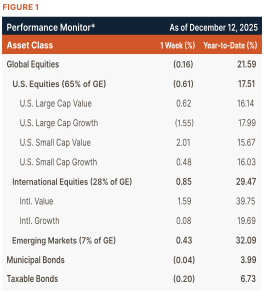
One of the more notable developments as year-end approaches is the narrowing gap between growth and value. After spending much of the year trailing, value stocks closed the distance meaningfully in recent months. Quarter-to-date, the Russell 1000 Value Index has outperformed the Russell 1000 Growth Index by roughly 4%, bringing the two styles into a near photo finish. Growth stocks remain ahead year-to-date, up approximately 18%, while value stocks are close behind at around 16%.
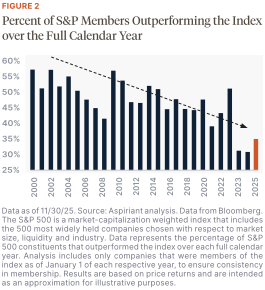
This rotation has not been abrupt or disorderly. Instead, it reflects a healthy reassessment of valuations and fundamentals, with investors allocating capital more evenly across sectors tied to industrial activity, financials, materials and consumer staples. As shown in Figure 2, the share of S&P 500 companies outperforming the index has trended lower over time, highlighting how concentrated market leadership has become relative to earlier periods such as the late technology, media and telecommunications (TMT) era. While breadth remains subdued, the recent uptick suggests participation has begun to improve this year. In that context, continued broadening is important—greater contribution from a wider set of companies can help reduce reliance on a narrow group of market leaders and support a more resilient foundation for diversified portfolios.
On the policy front, the Federal Reserve delivered a widely anticipated 25-basis-point rate cut last week, marking the third consecutive reduction this year. While the move itself was well telegraphed, updates to the Fed’s economic outlook were more notable. Policymakers modestly upgraded their 2026 growth forecast to 2.3% and lowered the projected path for core inflation to 2.5%, signaling cautious confidence that progress will continue on both fronts.
That said, a familiar disconnect remains. Fed officials currently project one additional rate cut in 2026, while markets are pricing in closer to three. This gap reflects ongoing uncertainty around the pace of inflation improvement, labor market dynamics and potential changes in Fed leadership next spring, factors markets will continue to weigh as the policy path unfolds.
Looking ahead, attention turns squarely to incoming economic data. This week’s delayed November employment report is expected to show modest job growth of around 40,000, with the unemployment rate holding steady near 4.4%. Hiring has clearly cooled over the course of the year, reflecting trade-related uncertainty as well as structural shifts tied to automation, AI investment and announced government workforce reductions.
Inflation data later in the week will be equally important. November CPI is expected to show headline and core inflation running near 3% year-over-year, roughly in line with recent readings. Encouragingly, several underlying pressures have eased. Home prices are rising more slowly, and oil prices remain well below previous peaks this year, helping contain broader inflation risks.
In 2025, investors navigated shifting leadership, changing policy signals and persistently heightened uncertainty. Yet, portfolios continued to adapt, often in quieter and more durable ways than the headlines suggested.
We’ve spent time with you helping interpret volatility, put short-term market moves into context and make thoughtful decisions when clarity felt scarce. Whether markets were reacting to inflation surprises, central bank shifts or rapid advances in technology, our focus remained the same: doing our best to help you stay confident and grounded in your long-term plan, emphasizing portfolio resilience and flexibility to evolve thoughtfully and unemotionally as conditions change.
The path into 2026 will bring its own set of questions and opportunities. We’ll share more perspectives during our upcoming Investing Outlook webinar on Jan. 22, where our Investment Team will discuss the forces shaping markets as we head into the new year. Additional details will be shared soon.

Source: Aspiriant analysis, data from Morningstar, Bloomberg, and the Federal Reserve Economic Database (FRED).
*U.S. Equities represented by the S&P 500 Index; a market-capitalization-weighted index that includes the 500 most widely held companies chosen with respect to market size, liquidity and industry. U.S. Large Cap Growth and Value Equities represented by the Russell 1000 Growth and Value Indexes; free float-adjusted market capitalization indexes that are designed to track large cap U.S. companies with either Value (lower price-to-book ratios and lower forecasted growth ratios) or Growth (higher price-to-book ratios and higher forecasted growth ratios) characteristics. U.S. Small Cap represented by the Russell 2000 Index, which measures the performance of the small-cap segment of the U.S. equity universe. It is a subset of the Russell 3000 Index representing approximately 10% of the total market capitalization of that index. It includes approximately 2,000 of the smallest securities based on a combination of their market cap and current index membership. U.S. Small Cap Growth and Value represented by the Russell 2000 Growth and Value Indices, which measures the performance of the small-cap growth and value segments of the U.S. equity universe. Global Equities represented by the MSCI ACWI Index; a free float-adjusted market capitalization weighted index that is designed to measure the equity market performance of 23 developed and 26 emerging markets, including the United States. International Equities represented by the MSCI EAFE (Europe, Australasia, and Far East) Index; a free float-adjusted market capitalization index that is designed to measure the equity market performance of developed markets excluding the U.S. and Canada. International Large Growth and Value represented by the MSCI EAFE Growth and Value Indexes (Europe, Australasia and Far East); free float-adjusted market capitalization indexes that are designed to measure the equity market performance of large and mid-cap developed markets exhibiting overall growth and value style characteristics, excluding the U.S. and Canada. Emerging Market Equities represented by the MSCI Emerging Markets Index, a free float-adjusted market capitalization index that is designed to measure equity market performance of emerging markets. Municipal Bonds represented by the Bloomberg Municipal Bond Index; an unmanaged index considered representative of the tax-exempt bond market. It consists of a broad selection of investment grade general obligation and revenue bonds of maturities ranging from one to 17 years. Taxable Bonds represented by the Bloomberg U.S. Aggregate Bond Index; a broad-based benchmark measuring investment grade, U.S. dollar-denominated, fixed-rate taxable bonds. No single index represents a benchmark for a globally diversified portfolio.
*The volatility of an index may be materially different than that of a model. Index returns assume the reinvestment of dividends and capital gains.
Want the latest wealth management tips, investment insights and Aspiriant news delivered straight to your inbox. Sign up for regular Fathom updates so we can send you the most relevant content you selected below.