Talk to us
 Wealth Planning
How Tax-Aware Long-Short Strategies Help Diversify Concentrated Stock




February 5, 2026

Our Investment Strategy & Research (IS&R) team shares its first-quarter 2026 perspective on the forces shaping today’s market environment. This brief examines AI-driven investment, economic divergence and market concentration — and how these dynamics are influencing investor decisions.
For a deeper discussion, read the full Insight report here.
Entering 2026, the global economy reflects a mix of resilience and strain. Growth has remained firm in key regions, but underlying pressures related to technology, energy, labor dynamics, fiscal constraints and geopolitics continue to shape how that growth is experienced. For investors, understanding not just the pace of expansion, but its distribution, is increasingly important. These dynamics help explain why maintaining a globally diversified investment portfolio continues to play a critical role.
One of the most important questions in this cycle is not only how fast the economy grows, but how the gains are distributed. A K-shaped economy describes widening divergence across stakeholders. Asset prices have risen, while consumer sentiment has weakened, especially since 2020, highlighting a growing disconnect between markets and lived economic experience (Figure 1). Because public equity ownership is highly concentrated, rising markets support spending and confidence for some households far more than others.
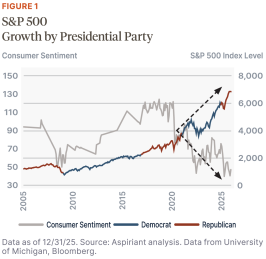
From a market’s standpoint, this divergence can persist for extended periods. From a policy standpoint, it tends to raise questions about fairness and the role of government. In the transition years ahead, political pressure is more likely to target the perceived winners from globalization and technology. That could include large companies, asset owners and the most profitable sectors.
For investors, the message is not to anchor on a single narrative about the consumer. Instead, it is to recognize that outcomes depend on which cohort is driving demand. When spending is led by higher-income households, the economy can look stable even as conditions weaken for the bottom half. That can delay traditional recession signals, but it can also lead to sharper changes when the top cohort eventually slows.
Importantly, AI has the potential to reinforce these K-shaped dynamics, particularly across employment, income growth and asset ownership, even as it drives faster productivity and investment.
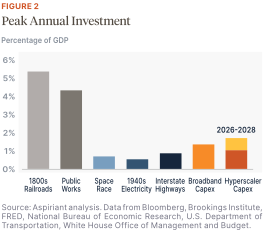
Capital investment tied to AI has accelerated rapidly, reflecting intense competitive dynamics among leading technology firms. If AI proves to be a general-purpose technology, long-term returns could be significant. If adoption is slower or economics disappoint, the capital intensity of the build-out could pressure cash flows and valuations.
What distinguishes this cycle is scale. As shown in Figure 2, projected AI-related investment rivals or exceeds levels seen during past transformational periods in U.S. economic history. Such cycles often persist because the technology is viewed as strategically important, but they also tend to produce periods of concentration and volatility.
Since the launch of ChatGPT, markets have rewarded AI-linked leaders disproportionately. Early-stage concentration is common in major transitions, but it can heighten fragility, as investor outcomes become more dependent on a narrow set of assumptions remaining intact.
Against this backdrop, we believe investors should emphasize three principles:
| Download Insight brief | Download full Insight analysis |



Aspiriant is an investment adviser registered with the Securities and Exchange Commission (SEC), which does not imply a certain level of skill or training. Additional information regarding Aspiriant and its advisory practices can be obtained at aspiriant.com.
This material is publicly available and provided for informational and educational purposes only. It reflects the views of Aspiriant as of the publish date indicated. All opinions, figures, charts/graphs, estimates and data included in this publication are as of the date indicated. The statements contained herein may include statements of future expectations, general market performance or economic conditions, and other forward-looking statements that are based on our current views and assumptions and involve known and unknown risks and uncertainties that could cause actual results, performance or events to differ materially from those expressed or implied in such statements. Forecasts, projections, and other forward-looking statements are based upon assumptions, current beliefs, and expectations. Forward-looking statements are subject to numerous assumptions, estimates, risks, and uncertainties, including but not limited to economic, business, market, and geopolitical conditions; U.S. and foreign regulatory developments relating to financial institutions and markets, government oversight, and fiscal and tax policy. Any forward-looking information should not be regarded as a representation by Aspiriant or any other person that estimates or expectations will be achieved, as the future is not predictable.
Past performance is not indicative of future results. There can be no assurance that any strategy will meet its investment objectives. All investments can lose value. The performance and volatility of an investor’s portfolio will not be the same as an index. Indices are unmanaged and have no fees. An investment may not be made directly in an index. The data used in this material was obtained from third-party sources the firm believes are reliable and from internal research. Aspiriant is not responsible for the accuracy or completeness of any third-party data used in the preparation of this presentation. This information alone is not sufficient and should not be used for the development or implementation of an investment strategy. It should not be construed as investment advice or a recommendation to any party. Investing in securities, such as equities, fixed income, and mutual funds, involves the risk of partial or complete loss of capital that prospective investors should be prepared to bear. Any reference to securities, directly or indirectly, is not a recommendation and does not represent a solicitation to buy or an offer to sell such securities. Any statistical information contained herein has been obtained from publicly available market data (such as data published by Bloomberg Finance L.P. and its affiliates), internal research, and regulatory filings.
Want the latest wealth management tips, investment insights and Aspiriant news delivered straight to your inbox. Sign up for regular Fathom updates so we can send you the most relevant content you selected below.